
The research peptide market has a problem that doesn’t get talked about enough. Independent testing has repeatedly shown that a significant percentage of products sold online contain less compound than labeled \and in some cases, none at all. Just water and filler in a glass vial with a professional-looking label.
It’s a structural problem created by the fact that this market operates with almost no regulatory oversight. That gap attracts two very different types of sellers: legitimate companies that invest in proper manufacturing and independent testing, and opportunists who’ve figured out that most buyers don’t know what to verify before they order.
If you’re asking where to buy peptides without getting burned, the answer starts with understanding what separates one category from another. Here are seven red flags that do exactly that.
Red Flag #1 – No Certificate of Analysis (COA) Available
The peptide COA is the most important document in this entire transaction. It’s a lab report confirming three things about a specific batch: that the compound is what the label says it is, that it meets purity standards, and that the actual amount of active compound matches what’s claimed.
Legitimate sellers publish these documents openly – typically linked directly on the product page, batch-specific, dated within the past year, and issued by an independent lab. A COA peptide document that comes from the seller’s own in-house testing carries almost no weight because there’s no independent verification of their equipment, their methods, or their honesty.
Red Flag #2 – No Third-Party Peptide Testing Lab Verification
Having a document isn’t enough. The third-party server peptide lab testing definition matters here: a genuine third-party lab is entirely independent from the seller – it has its own accreditation, its own equipment, and its own professional reputation to protect. It has no financial incentive to deliver favorable results to a seller.
A legitimate lab report clearly names the facility, includes contact information, and specifies the exact testing methods used. For peptides, that means HPLC for purity analysis and mass spectrometry for identity confirmation.
Some sellers produce documents that look legitimate at a glance but fall apart under basic scrutiny. The lab name is vague or doesn’t appear to exist. There’s no contact information. The stated methods don’t align with the data. A quick search on any recognized third party peptide testing lab – facilities like Janoshik Analytical or Pure Peptide Sciences have established track records in this space – will tell you whether the lab is real and whether the methods described are credible.
How to Actually Read a Peptide COA
Once you have the document in front of you, here’s what to actually check:
- Identity: The mass spectrometry data should match the exact molecular weight of the compound in question.
- Purity: HPLC results should be 98% or higher; anything below 95% indicates manufacturing quality issues.
- Batch number: Must exactly match the number printed on your vial.
- Testing date: Recent, ideally within the past few months, for the batch you’re ordering.
- Lab details: Facility name, contact information, and a chemist’s signature.
When your order arrives, the first thing to do is compare the batch number on the vial to the batch number on the COA. If they don’t match, that lab report didn’t test what’s in your hand.

Red Flag #3 – Prices That Are Too Good to Be True
High-purity peptide synthesis is genuinely expensive. Skilled chemists, precision equipment, raw materials, independent testing fees, cold-chain logistics – these costs establish a real price floor. When a peptide vendor is selling significantly below market rate, something in that cost structure has been cut.
Usually, it’s the compound itself. Underdosed vials are common in the low-price segment. Sometimes a cheaper, generic compound gets substituted for the expensive one on the label. In the worst cases – documented repeatedly in independent testing – vials contain no active ingredient at all.
Real peptide reviews from established research communities make this pattern very clear. Buyers who chased bargain prices consistently report no results, while buyers who paid standard market prices report predictable, consistent outcomes.
Red Flag #4 – Vague or Missing Product Information
Transparency is one of the clearest signals of a legitimate operation. A serious supplier tells you exactly what’s in the product: milligram content per vial, purity grade, batch number, production date, expiration date, and storage requirements.
Counterfeit sellers do the opposite. They rely on language like “premium” or “pharmaceutical grade” without backing it up with numbers. If a product page doesn’t list milligram content, that’s a red flag. If there’s no batch number or expiration date, that’s another. If storage instructions don’t include refrigeration for temperature-sensitive compounds, the seller either doesn’t understand basic peptide chemistry or doesn’t care about product integrity.
Peptide quality isn’t just about what’s in the vial; it’s about whether the compound is still viable when it reaches you. A seller who doesn’t address cold storage during shipping has already decided how much they care about what arrives at your door.
Red Flag #5 – Medical Claims and “Supplement” Labeling
This one doubles as a legal signal. Research compounds cannot legally be sold as dietary supplements or marketed with therapeutic claims. A seller who labels peptides as anti-aging treatments, workout enhancers, or anything suggesting medical benefit is either uninformed about the regulations or actively ignoring them.
Are peptides real compounds with legitimate research applications? Yes, absolutely. But are peptides real when they’re being sold in a supplement store alongside vitamins with dosing instructions for personal health use? That context should raise immediate questions. A company willing to ignore legal labeling requirements has already demonstrated they’re willing to cut corners. The same disregard tends to show up in their testing practices.
Specialized research suppliers operate within the correct legal framework. They label products accurately, include appropriate research-use disclaimers, and don’t make claims that would attract regulatory scrutiny.
Red Flag #6 – No Verifiable Reputation or Reviews
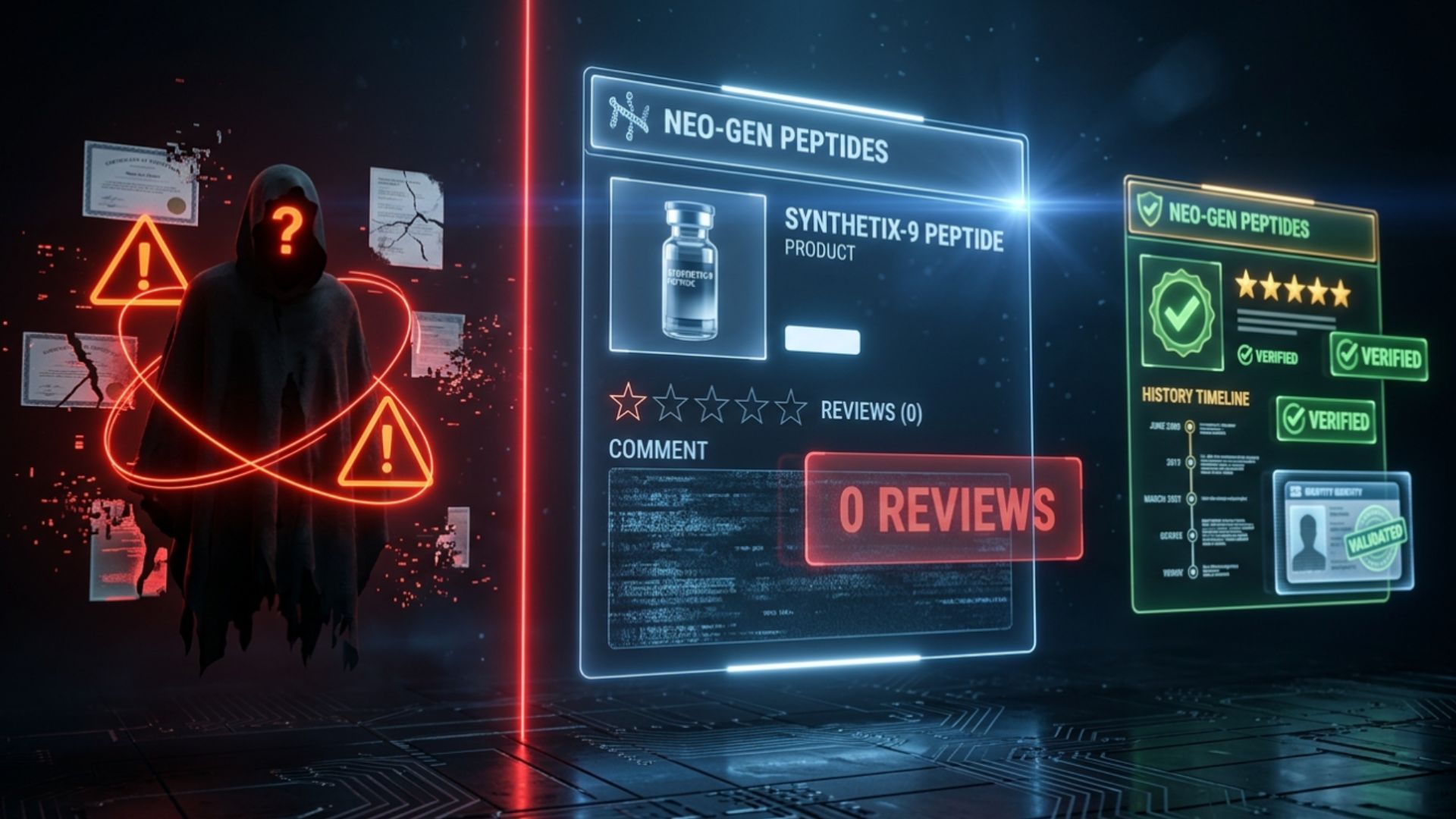
Peptide source reviews from independent communities are one of the most reliable filters available. Active research communities on Reddit, dedicated forums, and independent review platforms have been evaluating suppliers for years. Real feedback accumulates over time: it includes specific batch numbers, honest accounts of both good and bad experiences, notes on shipping speed, customer service, and product consistency.
Real peptide reviews built up over multiple years look very different from manufactured reviews on a seller’s own website. Legitimate suppliers are openly discussed in places they don’t control. Fake or low-quality operations tend to either have no outside presence at all – because they rebrand every few months to escape negative feedback – or an implausibly perfect review record that exists only on their own platform.
When evaluating a peptide source, search for the company name on independent boards and see what actual researchers say. The most reliable peptide source isn’t necessarily the one with the most polished website; it’s the one the community has consistently trusted for years.
The best peptide source has peptide source reviews spread across multiple independent platforms, not just its own product pages.
Red Flag #7 – Suspicious Packaging, Shipping, and Storage Practices
Packaging is the final checkpoint. What arrives at your door reflects how seriously a supplier treats the product they’re selling.
Legitimate shipments arrive with:
- Ice packs or cold insulation for temperature-sensitive compounds
- Intact crimp tops on glass vials
- Clear labels with batch numbers that match the COA on file
- Appropriate protective packaging that survives standard shipping conditions
What fake or low-quality operations typically send:
- Temperature-sensitive compounds are shipped in standard warm envelopes with no insulation
- Generic or missing batch labels
- Cloudy or discolored liquid in vials that should contain clean, freeze-dried powder
- Damaged, leaking, or visibly compromised vials
Cold-chain handling isn’t a luxury; it’s a basic requirement for maintaining compound integrity from manufacture to use. A seller who doesn’t address it doesn’t understand what they’re selling.
At Iron Peptides, every shipment includes proper cold packaging, batch-matched labels, and a third-party COA available before you order. That’s the standard.
How to Choose the Best Peptide Source – Putting It All Together
Figuring out where to buy legit peptides comes down to running through this checklist systematically, not just checking one or two boxes.
The best peptide source publishes independent COAs for every batch, uses recognized testing facilities, labels products with precise milligram content and expiration dates, ships temperature-sensitive compounds with proper cold packaging, and has a track record of honest, real peptides reviews across independent research communities. They charge fair market prices. They don’t make supplements or medical claims. And they answer questions directly because they have nothing to hide.
Where to buy peptides safely isn’t really a mystery once you know what to look for. The markers of a legitimate operation are consistent and verifiable. The markers of a problematic one are equally consistent.
Treat your first order with any new supplier as a test. Place a modest order, verify the batch numbers against the COA, and assess the shipping handling. A legitimate peptide source will welcome that scrutiny. They’ve already done the work to earn it.
This article is for educational purposes only. All compounds discussed are sold strictly for research use and are not approved for human consumption, medical treatment, or therapeutic application.