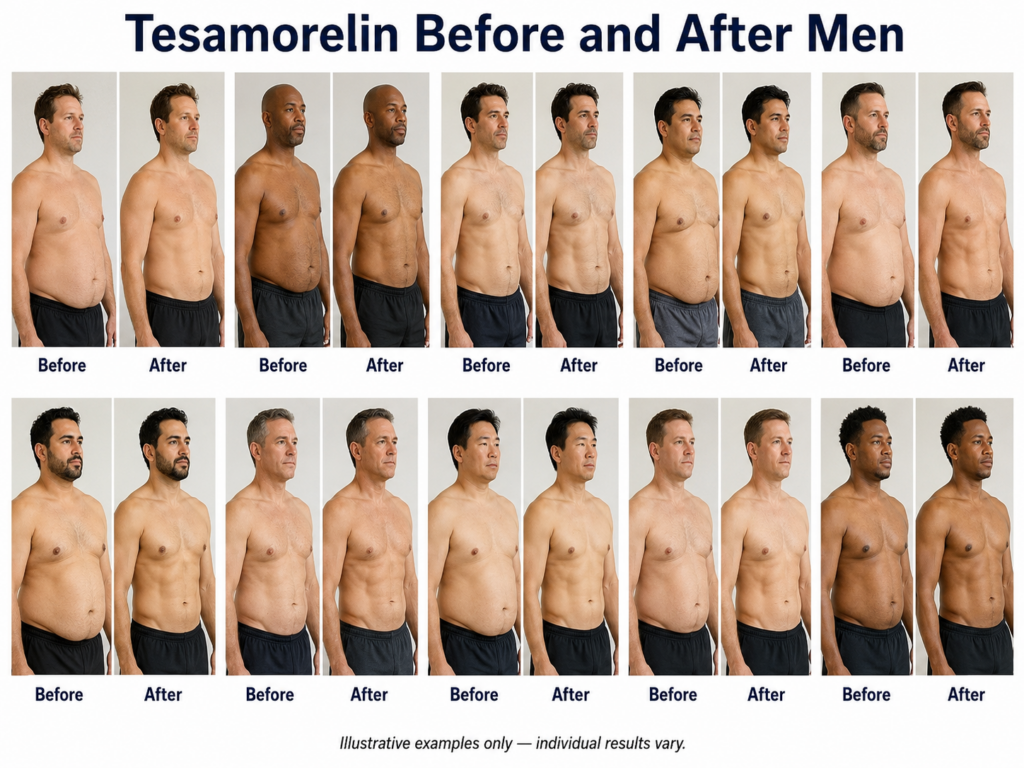
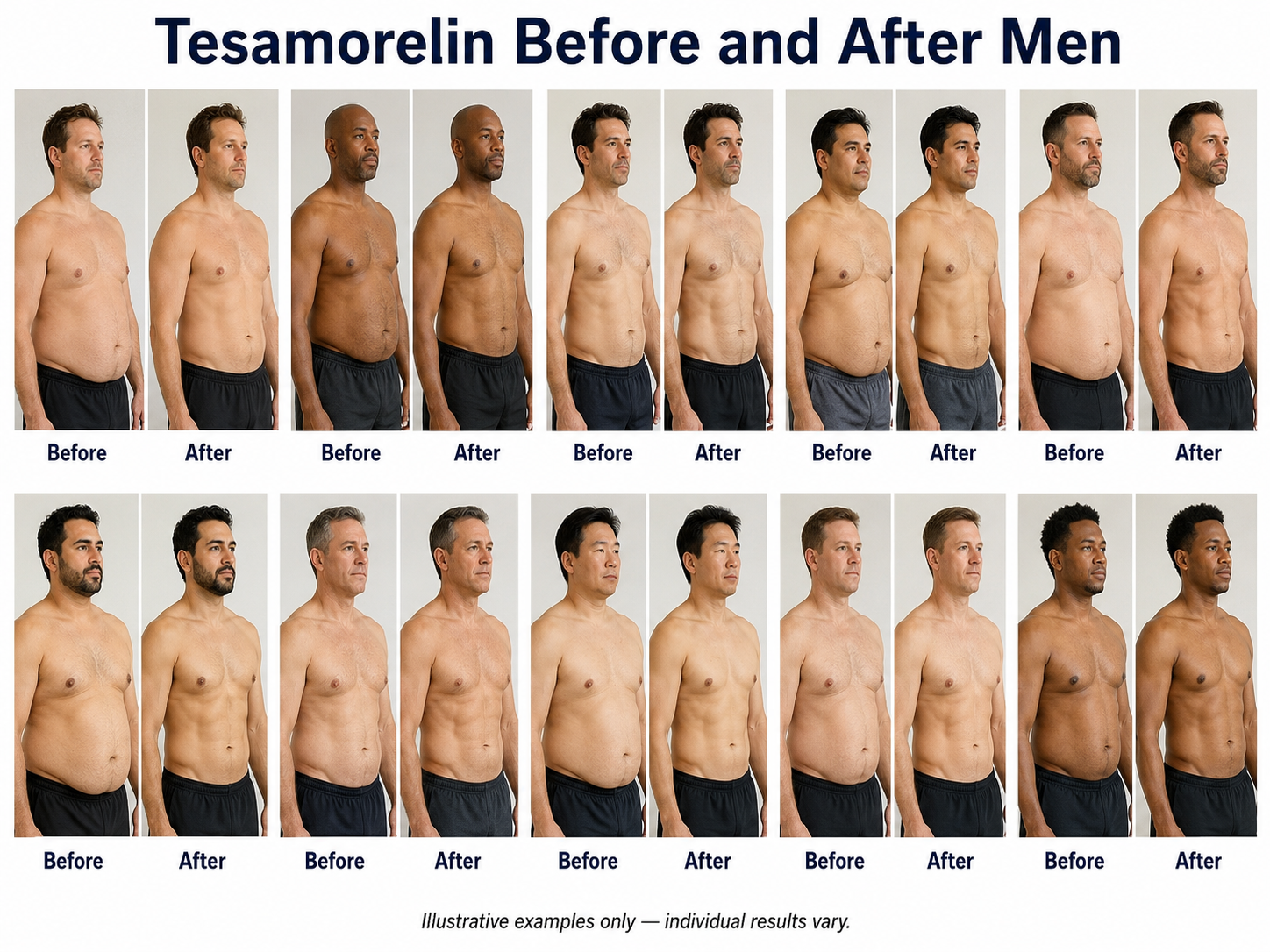
Men researching tesamorelin before and after results are usually asking one specific question: does this actually change visceral fat and body composition, or is it just marketing language borrowed from the HIV-lipodystrophy trials it was originally studied for. The honest answer is that tesamorelin’s before-and-after picture in men looks different from what gets shown in generic peptide marketing — the changes are gradual, concentrated in the midsection, and tied closely to how consistently the research protocol is followed. This article breaks down what the research literature actually shows, week by week, for research purposes only.
Week 1–2: No visible change, but the mechanism is already active
In the earliest phase, researchers report no visible shift in male subjects — this is the phase where GHRH receptor activation in the anterior pituitary is being studied for its downstream effect on pulsatile growth hormone release. IGF-1 levels are the first measurable marker to move in research models, typically before any change in waist circumference or visceral fat imaging. Men expecting a fast before-and-after transformation at this stage are working from an inaccurate timeline — the compound’s studied mechanism is slow and cumulative, not immediate.
Week 4–6: Early visceral fat signal
By roughly the one-month mark, research subjects begin showing the first measurable reduction in visceral adipose tissue on imaging, which lines up with why “tesamorelin before and after 1 month” is a common search among men tracking their own research protocols. This is also typically when subjects first report subjective changes in waist fit, though subcutaneous fat (the visible, pinchable layer) tends to lag behind visceral fat loss. Male body composition studies specifically noted visceral fat reduction as more pronounced than in comparable female cohorts, likely due to baseline differences in fat distribution patterns between sexes.
Week 8–12: The clearest before-and-after window
Most of the photographic “before and after” comparisons circulating online — and most of the clinical trial data — cluster around the two-to-three-month mark. This is where visceral fat reduction becomes visually apparent in men, waistlines narrow further, and IGF-1 elevation has typically plateaued to a stable, sustained level in research models. It’s also the point where the muscle question comes up most often: does tesamorelin build muscle, or does it just remove fat? Research suggests it’s closer to the second — the growth hormone axis stimulation is associated with preserving and modestly supporting lean mass rather than driving significant hypertrophy on its own. Men expecting bodybuilding-style muscle gain from tesamorelin alone are likely to be disappointed; the compound’s studied strength is fat metabolism, not muscle-building in isolation.
Real Tesamorelin Before and After Examples: What’s Actually Being Posted
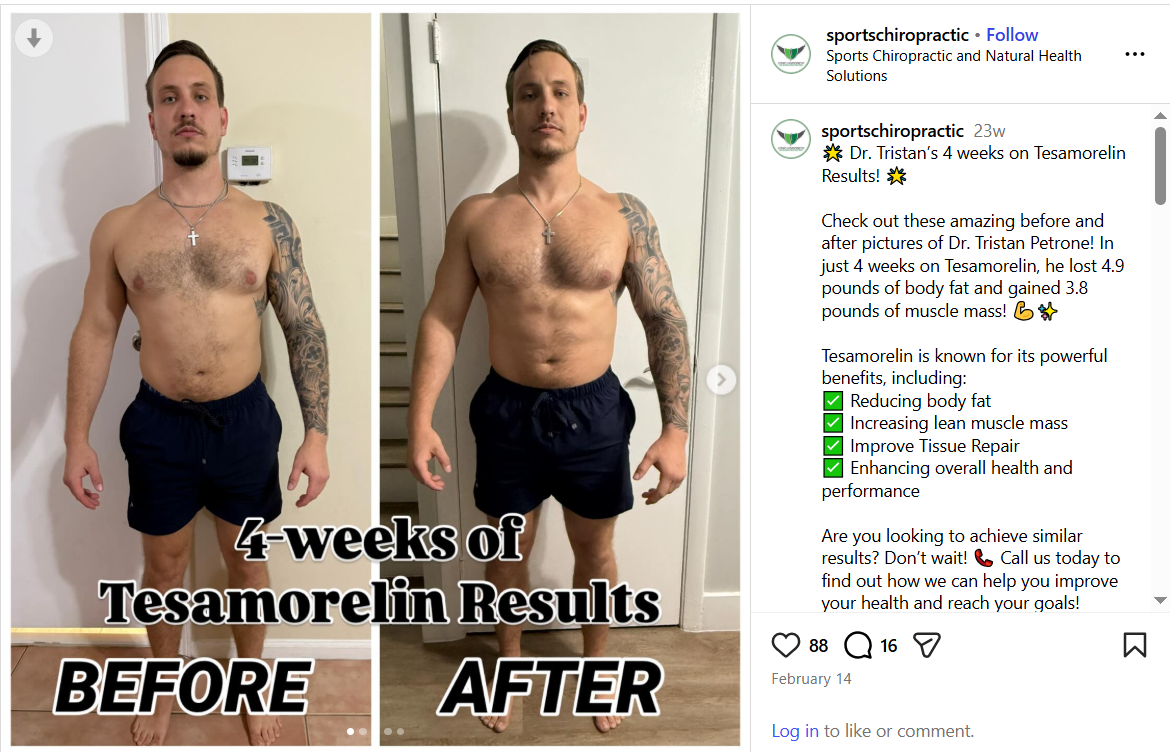
Beyond clinical data, real posts across social platforms give a grounded look at what tesamorelin timelines actually look like in practice — and most track closely with the research above rather than showing the dramatic, fast transformations often implied by generic marketing.
- 4-week check-in from a provider account — lands in the early visceral-fat-signal window rather than showing a dramatic shift, a useful reality check against posts promising fast results
- Visceral fat explainer reel — makes the point that not all fat responds the same way; the deep abdominal fat tesamorelin targets is different from the pinchable subcutaneous layer most men picture when searching “before and after” photos

- 6-month transformation post from 4Ever Young Center City Philly — shows tesamorelin stacked with a GLP-1 protocol rather than used alone, a combination increasingly common in what men are searching for, though it makes isolating tesamorelin’s individual contribution harder to read from photos alone
YouTube
- “It Crushes Visceral Fat, But the Scale Barely Moves” — the single most important expectation-setting point in circulation right now: the scale is the wrong metric to track. Waist circumference and composition are what actually move.
TikTok
- Before/after pics discovery tag page — an aggregated tag rather than one post, but confirms this is active search/content behavior on the platform too
What about the “puffy face” concern?
This is one of the more searched side-effect questions specific to GHRH-analog research, and it’s a legitimate one. Elevated growth hormone activity has been associated with fluid retention in some research subjects, which can present as mild facial or peripheral puffiness, particularly at higher doses or in subjects with a faster response curve. This effect is typically transient in the literature and tends to resolve as the body adjusts, but it’s a documented variable worth tracking in any research log rather than dismissing.
Why the male-specific picture differs from generic tesamorelin content
Most tesamorelin before-and-after content online isn’t segmented by sex, which is a gap — male and female research subjects show measurably different visceral-to-subcutaneous fat ratios at baseline, meaning the same research protocol can produce a different visual timeline in men versus women. This is worth keeping in mind when comparing personal research notes against before-and-after content that doesn’t specify the subject population. If you’re tracking your own research protocol, comparing against studies with matched demographics gives a far more accurate baseline than generic marketing photos or social posts.
Research-grade sourcing matters more than the timeline
None of the timeline data above is useful if the underlying peptide isn’t verified for purity and identity. A large share of inconsistent “before and after” reports — the ones that show no change at all, or unpredictable side effects — trace back to underdosed or contaminated research material rather than a failure of the mechanism itself. This is where sourcing from a lab that provides a batch-specific Certificate of Analysis becomes relevant to research integrity, not just as a purchasing consideration.
Final take for researchers
The realistic tesamorelin before-and-after picture in men is a slow, visceral-fat-led process that becomes visually apparent somewhere in the two-to-three-month window of a research protocol, with facial puffiness as an occasional and typically transient variable to log. It is not a muscle-building compound in isolation, and it is not a fast transformation. For research teams designing their own tracking protocol, comparing against sex-matched clinical data — rather than generic before-and-after marketing — will produce a far more reliable set of expectations. Explore the full peptide research catalog at Iron Peptides for COA-verified compounds used across GHRH and growth hormone axis research.
This article is for informational and educational purposes only. Tesamorelin and all products referenced are intended strictly for laboratory research use and are not approved for human consumption, diagnosis, treatment, or prevention of any disease.