
When a stack of several compounds becomes part of your routine, a logical question naturally arises: Is it possible to mix everything into a single vial or syringe so you can give one injection instead of several? But here we need to consider issues of chemistry, stability, and safety. And the answer depends on the specific compounds, not on a general rule.
In this article, we’ll discuss what you need to know about peptide compatibility when mixing, which combinations are considered viable, and how to approach mixing for injection from the perspective of stability and sterility.
Important! This material is for informational and overview purposes only and does not constitute recommendations for specific actions. The decision to use peptides should be based solely on medical indications and your doctor’s recommendations.
Can You Mix Peptides? The Basic Principle
Can you mix peptides? This question has two distinct contexts, and it’s important to distinguish between them from the outset:
- The first concerns injectable peptides, which are mixed in a single vial or syringe for ease of administration.
- The second concerns topical peptides in cosmetics, which are “mixed” with other active skincare ingredients (vitamin C, retinol, acids).
In the context of injections, whether you can mix peptides together depends on chemical compatibility, pH, stability in solution, and sterility. Many peptides are described as compatible when mixed if they dissolve in the same solvent, have a similar pH stability range, and do not chemically interact with one another. This is precisely why ready-made combination mixtures, such as GLOW or KLOW, have become popular: the manufacturer has already tested compatibility for you.
Key principle: mixing is possible not because “peptides are generally compatible,” but because specific compounds with specific characteristics do not interfere with one another when stored and administered together.
Chemical Compatibility – What Can and Can’t Go Together
When it comes to peptide compatibility in solution, several factors determine whether mixing will be beneficial or destructive to one of the components.
- pH stability range. Each peptide has a pH range within which it remains stable. Mixing two compounds with incompatible pH ranges can degrade one or both. Most peptides are stable in a neutral or slightly acidic range, but there are exceptions, and these must be verified for specific compounds.
- Solvent. Bacteriostatic water is the standard solvent for most injectable peptides, and this in itself reduces the risk of incompatibility. Problems are more likely to arise if one of the compounds requires a different solvent; in this case, mixing it in the same vial with another peptide dissolved in water creates a heterogeneous solution with an unpredictable concentration upon withdrawal.
- Chemical Interaction. Some peptides contain functional groups that can react with other compounds upon prolonged contact. This is not an instantaneous reaction, but the risk increases when the mixture is stored for several weeks.
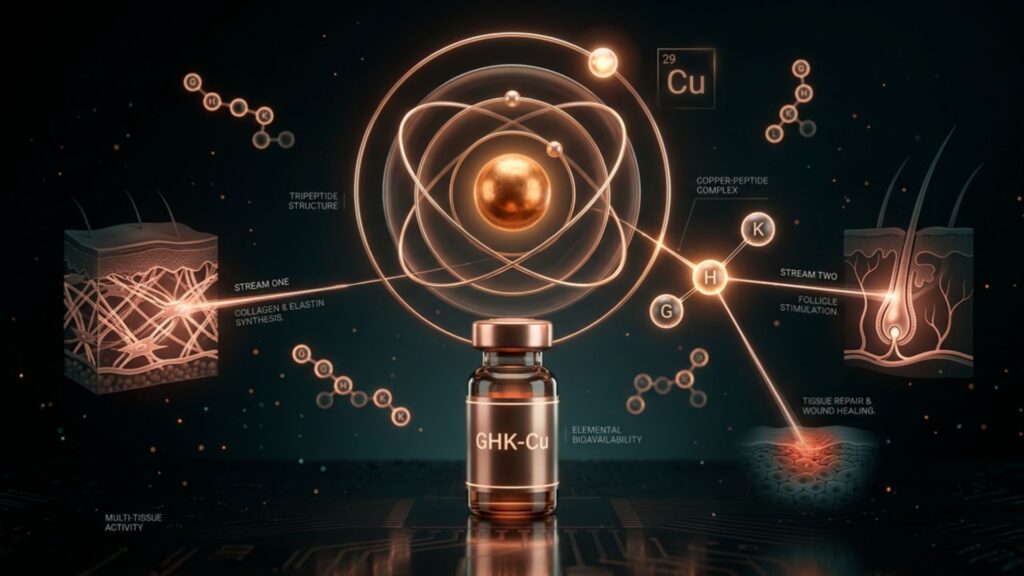
The good news: popular combinations within the same “category” for example, BPC-157 and TB-500 (both wound-healing agents, both highly soluble in bacteriostatic water with a neutral pH) are described as compatible and are widely used together. GHK-Cu and BPC-157 follow a similar pattern. Compounds with different “functions” and different chemical profiles require separate testing before mixing.
pH and Solvent Conflicts to Know
Copper peptides (GHK-Cu) are one example where caution is needed when mixing. Copper, as a cofactor, can interact with other compounds containing groups that are sensitive to oxidation. When mixed with peptides containing cysteine or other reactive groups, a reaction is theoretically possible that could reduce the activity of one of the components.
Compounds that require an acidic environment to dissolve and compounds that are stable only at neutral pH present another potential conflict. If one component of the mixture shifts the solution’s pH into a range unfavorable to the other, degradation may occur gradually and go unnoticed by the user.
Practical conclusion: Before mixing anything in a single vial, it’s worth checking the stability pH ranges and solvents for each specific compound, rather than assuming that “since both peptides are involved, they must be compatible.”
Can You Mix Peptides in One Syringe? Practical Considerations
Can you mix peptides in one syringe? This is one of the most common practical questions, and it’s important to distinguish between two scenarios: mixing in a single vial for long-term storage and drawing two compounds into a single syringe immediately before administration.
The second scenario is significantly less risky in terms of stability: the contact time between the compounds is minimal – a few minutes, rather than days or weeks. Can you mix peptides in the same syringe immediately before administration? It is a practice used by many, precisely because the risk of degradation from brief contact is incomparably lower than during long-term storage of the mixture.
At the same time, can you mix peptides in one injection is not only a question of chemistry but also one of volume. Combining several compounds into a single syringe increases the total injection volume, and if that volume proves uncomfortable for a subcutaneous injection, that alone is an argument in favor of separating them.
Can you mix peptides in the same syringe before administration? The answer is most often “yes, for compatible compounds,” with the caveat that you should draw them up in sequence, minimize the time the mixture spends in the syringe before administration, and not leave the filled syringe in storage.
Stability After Mixing – How Long Does It Last?
A mixed solution of several peptides in a single vial does not have the same shelf life as each compound individually. This is an important point that is often overlooked.
The stability of the mixture is determined by its least stable component. If one of the peptides begins to degrade after two weeks of refrigerated storage, the entire mixture in that vial effectively has a two-week shelf life – even if the other component could be stored longer. When mixing in a single vial, it makes sense to go by the shorter of the two stability periods and opt for small batches of the mixture rather than large volumes “just in case.”

Skincare Crossover – Peptides, Vitamin C, and Retinol
A separate and much-discussed topic is the compatibility of peptides in skincare. Here, questions like “can you mix peptides and retinol?” and “can you mix vitamin C with peptides?” come up constantly, and the answers differ from those in the context of injectable treatments.
With vitamin C, the situation is as follows: ascorbic acid (the most common form of vitamin C in cosmetics) has a low pH and acts as a reducing agent. Copper peptides (GHK-Cu) combined with vitamin C represent one of the most extensively studied incompatibilities: ascorbic acid can reduce copper from Cu²⁺ to Cu⁺, altering the active form of the copper complex. The recommendation to apply them at different times of day (for example, vitamin C in the morning, copper peptides in the evening) is standard practice in this field.
With retinol, the situation is slightly different. Can you mix peptides and retinol in a single application – this isn’t a chemical conflict in the same sense as with vitamin C: most peptides are chemically compatible with retinol. The issue is that retinol works best at a specific pH, and some buffering systems in peptide serums may interfere with that. Additionally, if retinol causes skin irritation, applying additional active ingredients puts extra strain on the skin barrier. Staggering application, retinol in the evening and peptides separately, is considered a more predictable strategy than mixing them into a single application.
When Mixing Makes Sense vs. When to Keep Separate
Not all situations are equally conducive to mixing. There is a logic by which convenience is justified, and a logic by which separation makes sense.
Mixing in a single vial or syringe is considered reasonable when:
- Both compounds have the same solvent and a compatible pH
- The goal of mixing is convenience, not cost savings, without understanding compatibility
- The volume of the mixture is small and will be used within a short period of time
- This refers to ready-made commercial mixtures where the manufacturer has already verified compatibility
Separation makes sense when: one of the compounds requires a different solvent; the pH stability ranges do not overlap; one component contains copper or other metals that can interact with other peptides; or long-term storage of the mixture is anticipated.
Safety, Sterility, and Final Takeaways
In addition to chemical compatibility, mixing introduces another, less frequently discussed risk – sterility. Every time a needle enters a vial, there is a theoretical risk of contamination. Mixing multiple compounds in a single vial involves repeatedly opening different vials and transferring their contents, and each extra step increases the risk of a breach of sterility.
Bacteriostatic water contains benzyl alcohol specifically as a preservative against bacterial growth, which partially reduces this risk. However, adherence to aseptic technique – working on a clean surface, using alcohol wipes to swab stoppers, storing in the refrigerator, and discarding vials showing signs of cloudiness – remains mandatory regardless of whether you are working with a single compound or a mixture.
To summarize: mixing peptides in a single vial or syringe is a common practice, and for many combinations it is considered feasible. However, this is not a universal “yes”; it depends on the specific compounds, their chemical properties, and storage conditions. Ready-made commercial mixtures are the easiest way to ensure proven compatibility. Mixing them yourself requires understanding, not just a desire to save money on injections.
One point that’s often overlooked: even if two compounds are chemically compatible, that doesn’t mean combining them will automatically produce a more pronounced result. The logic that “more in one means better” doesn’t work quite so straightforwardly when it comes to peptides. Each compound has its own optimal environment, stability conditions, and sometimes preferred sites and routes of administration. Ease of mixing is a compelling argument, but it’s not the only criterion.
Important. All peptides mentioned in this text are provided for informational purposes only. The final decision regarding their use, mixing, and method of administration must be made by a qualified specialist, taking into account the individual’s health status, medical history, and current medications.