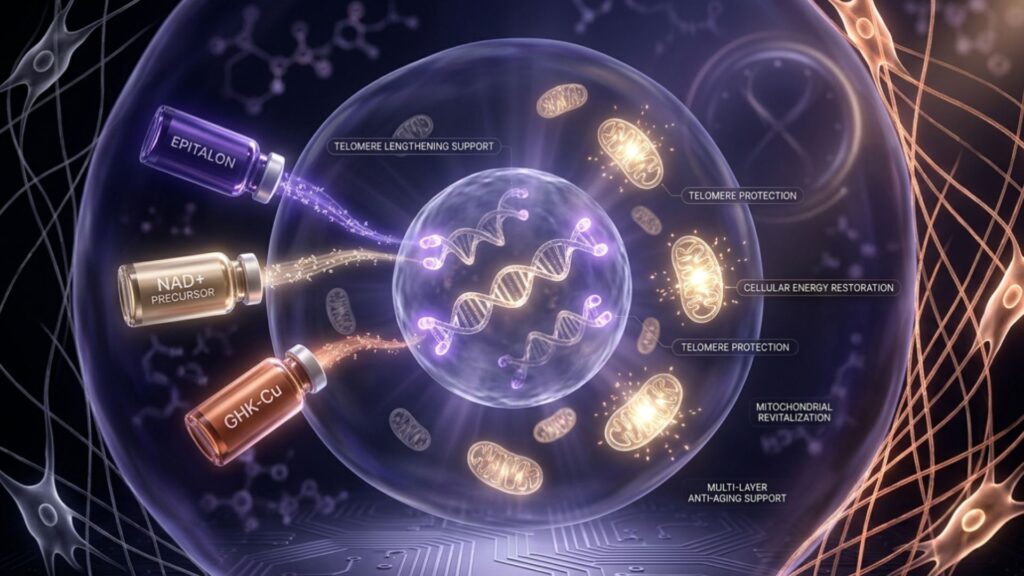
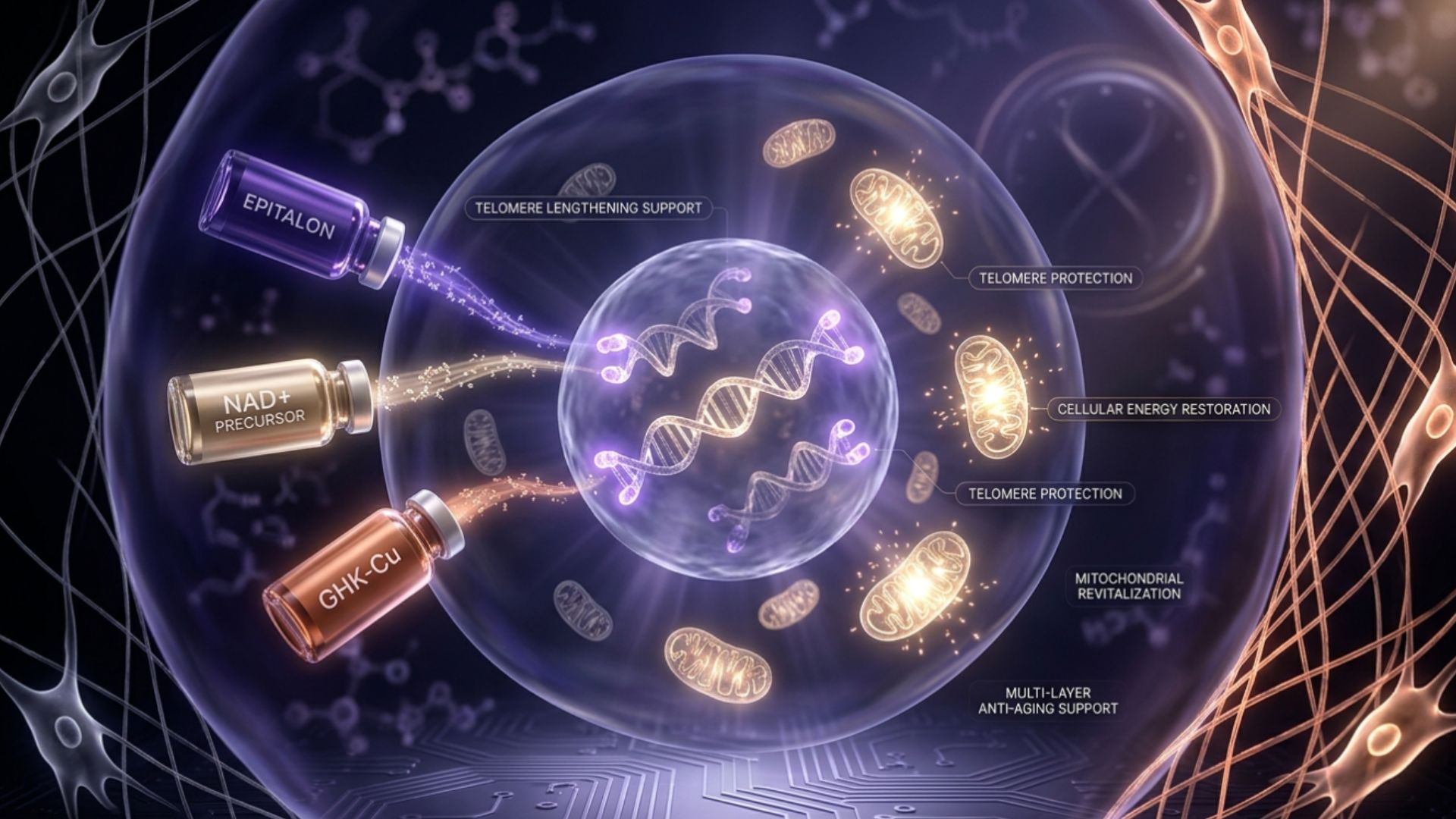
Peptides have long since moved beyond the realm of conventional medicine. They are increasingly found in the biohacking community as tools people use in pursuit of longevity and wellness. In discussions of longevity (not just age but also appearance), a combination of three compounds is increasingly common: Epitalon, GHK-Cu, and NAD+. They are grouped under the umbrella term longevity peptides, although in terms of origin, mechanism, and the extent of research, they are completely different compounds.
Here’s how the conversation around peptides for longevity typically unfolds: there is interest in slowing age-related changes, the research base is interesting in places, but human data is noticeably scarcer than those seeking ready-made answers would like. Therefore, in this article, we will strive to clearly distinguish between what is being studied and what is a fact. Let’s establish the framework right away: everything discussed below pertains to research compounds that are not approved for medical use in humans, and this material is for informational purposes only.
What Is Epitalon? Background on the Peptide
Epitalon (sometimes spelled Epithalon) is a synthetic peptide consisting of four amino acids, developed based on a compound naturally produced by the pineal gland. The idea for creating this peptide arose from research into how the function of the pineal gland and related processes change with age.
Epitalon peptide falls into the category of investigational compounds: it is not registered as a drug for widespread use. It does not have approval as an anti-aging therapy in most countries. Some of the early research was conducted in laboratory settings (in Russia, where the compound was developed) and included experiments on cell cultures and animal models.
It is important to understand the context: the fact that the compound has existed and been studied for more than a decade does not mean that it has undergone the clinical trials that drugs undergo before registration. To date, Epitalon remains precisely a subject of scientific interest, not a ready-made answer to the question “how to slow down aging.”
Epitalon and Longevity: What the Research Explores
When people talk about Epitalon peptide benefits in the context of longevity, they most often refer to a specific area of research – its effect on the pineal gland and, in particular, on the regulation of melatonin production. There is also interest in the enzyme telomerase and telomere length, which are traditionally associated with cellular aging.
Some of the data on telomeres and lifespan have been obtained from experiments in cell cultures and animals (primarily rodents). Still, it is premature to apply these results directly to humans. There are significantly fewer human studies (though they do exist, and this is already a potential advantage over many other modern peptides).
However, it is still too early to speak of a proven effect on human lifespan based on human studies.
In other words, Epitalon’s benefits in this context are best described using phrases like “being studied in the context of” or “considered an area of interest,” rather than as a fact. The topic is indeed interesting and continues to attract research attention. Therefore, we hope that in the near future we can expect even more research results to confirm these effects.
Where GHK-Cu and NAD+ Fit in the “Stack”
It’s logical to ask: why are GHK-Cu and NAD+ almost always mentioned alongside Epitalon in these discussions? The answer is more “historical” and thematic. The fact is that all three compounds often appear in the same information space dedicated to aging. Each of these three peptides is, in one way or another, associated with aspects of age-related changes.
GHK-Cu (copper tripeptide) is more often discussed in the context of skin, connective tissue, and healing – that is, more as a “local” player. NAD+ (more precisely, its precursors) joins this group because of its role in cellular energy metabolism, which is believed to decline with age.
Important: The fact that these three compounds are regularly mentioned together reflects how the discussion of longevity is structured in general, not a recommendation for their combined use. Each has its own research context, and grouping them into a single “stack” is more a product of the community than the result of clinical trials specifically testing this combination.

Discussed Benefits and What People Search For
If we look at what people typically search for with the query “Epitalon benefits,” the set of topics is fairly consistent. Most often, the discussion centers on the following areas of interest:
- Effects on the regulation of circadian rhythms and melatonin production, which are linked to sleep quality.
- Interest in telomeres and telomerase in the context of cellular aging.
- General statements about “antioxidant effects” and support for hormonal balance with age.
- Mentions of a possible impact on immune function in the context of age-related changes.
At the same time, the Epitalon peptide benefits reported in reviews and forums are, in most cases, based either on preclinical studies or on users’ personal observations, which, by definition, are not controlled data. This does not mean that such observations are useless, but it does mean that it would be incorrect to interpret them as a proven effect.
The honest take here is this: the topic exists, and the interest in it is understandable from a mechanistic standpoint, but the transition from “theoretically interesting” to “works in people” is precisely the part of the journey that has not yet been completed. However, given the significant interest and active discussion surrounding peptides, we can expect upcoming studies to confirm or refute the results.
“Epitalon Dosage” Searches: Why There’s No Simple Answer
The search query “Epitalon dosage” is one of the most frequent in this topic, and that is precisely why it is worth explaining separately why there is no simple answer.
- First, there is no approved medical dosage for humans for Epitalon – that is, there is no official document to refer to, unlike with registered drugs. Any figures found online are based on user experience, extrapolations from animal studies, or internal agreements within specific communities (but not on clinically validated protocols).
- Second, Epitalon peptide dosage is a question that, in principle, cannot have a universal answer: it is influenced by age, health status, comorbidities, medications being taken, and a multitude of individual factors that no single article can assess.
Therefore, instead of providing specific numbers – which would give the reader a false sense of a “proven regimen” – we deliberately leave this question where it belongs: within the purview of the doctor who sees a specific person, not an abstract blog reader.
About “Dosage Calculators” for Peptides
It’s worth mentioning the Epitalon dosage calculator – a format that people often search for alongside the topic of dosages. The logic behind the search is clear: a person enters their weight or age, gets a number, and feels like the issue is resolved.
The problem is that such a calculator essentially mimics a medical prescription, but without a doctor’s involvement and without taking the actual clinical picture into account. Any formula that generates a “personalized dosage” based on a couple of parameters creates an illusion of accuracy where it objectively cannot exist, especially for a compound that lacks an established dosage range for humans.
On our website, you can find a peptide calculator, but not for personal use, rather for accurately comparing BAC water and research peptides. Our calculator helps determine the correct dosage for research purposes. To determine the correct dosage for you, consult a doctor first, and then decide whether to use the peptide.
Side Effects and Safety Considerations
When it comes to Epitalon side effects, honesty is just as important here as it is in the section on dosages. According to available data, small studies and user reports most often mention relatively mild reactions: discomfort at the injection site, occasional fatigue, or changes in sleep quality during the first few days of use.
At the same time, it is important to emphasize the main point: there are no large-scale, systematic safety studies of Epitalon in humans comparable to those conducted for approved drugs. This means that there is objectively insufficient data on long-term effects, drug interactions, and safety in chronic diseases. And this is not because the compound is “dangerous,” but because this research simply has not been conducted to the necessary extent.
From a regulatory standpoint, Epitalon, like most compounds in this category, is classified as “for research purposes only” and is not approved as a drug or dietary supplement for humans in most countries.
Any decision regarding its use goes beyond the scope of this informational article and falls within the realm of medical decisions that should be made in consultation with a doctor, especially in the presence of chronic conditions, while taking other medications, during pregnancy, or when planning a pregnancy.
Key Takeaways and Common Questions
To summarize the information in a convenient format, let’s answer a few questions that most frequently arise regarding this topic.
Is this the same as other longevity peptides? No, each compound in this category has its own mechanism, origin, and level of research. Grouping them under a common name reflects the topic of discussion rather than a unified scientific basis.
Is Epitalon a good place to start if you’re interested in peptides for longevity in general? The research interest is real, but as with the other compounds discussed here, the decision should be made exclusively by a qualified doctor.
Why doesn’t the article include any specific dosage figures? Because there is no approved dosage range for humans regarding Epitalon, and any figures from open sources represent someone else’s experience that cannot be directly applied.
Can Epitalon be considered safe? The available data do not describe any serious risks, but they also do not resolve the issue of long-term safety. It is more accurate to say that this area has not yet been sufficiently studied than to draw definitive conclusions in either direction.
Important. All peptides mentioned in this text are provided for informational purposes only. The final decision regarding their use must be made by a qualified specialist, taking into account the individual’s health status, medical history, and medications being taken.