

What Is Epitalon? Telomeres, Aging, and Longevity Research Explained
Last Updated: May 30, 2026
By: Rusty Ryan, PharmD Candidate & Lead Researcher at Iron Peptides (5+ years specializing in peptide pharmacokinetics, longevity interventions, and cellular aging).
DISCLAIMER: This article is for informational purposes only. Epitalon is not approved by the FDA, EMA, or any major regulatory agency for human therapeutic use. Nothing in this article constitutes medical advice, diagnosis, or treatment. Consult a qualified, board-certified healthcare provider before considering any peptide therapy — particularly if you have a history of cancer, autoimmune conditions, or are taking prescription medications.
“Epitalon sits at a fascinating crossroads in longevity science — the mechanism is biologically plausible, the telomerase connection is real, but the clinical evidence hasn’t caught up with the hype. My goal here is to give you the full picture: what the research actually shows, where the gaps are, and why caution matters more than enthusiasm when it comes to peptides that interact with cancer-associated pathways.” — Rusty Ryan, Iron Peptides
TL;DR: The Epitalon Summary
- What it is: A synthetic tetrapeptide (Ala-Glu-Asp-Gly) derived from Russian research on pineal gland extracts, designed to target cellular aging at the chromosomal level.
- How it claims to work: Primarily by activating telomerase — the enzyme that adds protective length back to chromosome ends — and by restoring the pineal gland’s natural melatonin production.
- The Evidence Gap: Cell-line and animal data show promise, but large-scale, independent Western clinical trials on humans are nonexistent. Epitalon remains classified as an unapproved drug.
- The Major Risk: Epitalon activates telomerase via hTERT in normal cells, but recent data shows it can also trigger the ALT (Alternative Lengthening of Telomeres) pathway in certain cancer cells — making it a high-risk compound for anyone with oncology concerns.
What Is Epitalon Peptide and How Was It Discovered?
Epitalon is a synthetic tetrapeptide with the amino acid sequence Ala-Glu-Asp-Gly (alanine, glutamic acid, aspartic acid, and glycine). It was developed from research on epithalamin, a pineal gland extract first studied by Professor Vladimir Khavinson at the Institute of Biogerontology in Leningrad (now St. Petersburg) during the 1980s.
Khavinson’s team was investigating the “neurohormonal theory of aging”—the idea that age-related decline stems partly from reduced pineal gland function and falling melatonin production. They isolated the core bioactive sequence from bovine glands, which became the synthetic peptide Epitalon.
Epithalon vs Epitalon vs N-Acetyl Epitalon Amidate
- Epithalon: Usually refers to the original crude pineal gland extract.
- Epitalon: Refers specifically to the synthetic tetrapeptide.
- N-Acetyl Epitalon Amidate: A chemically modified version designed to resist enzymatic degradation. It features N-acetylation (protects the “front” end) and C-terminal amidation (protects the “back” end), theoretically extending its functional half-life.
Telomeres, Telomerase, and the Anti-Aging Mechanism
Every time a cell divides, the protective caps at the ends of chromosomes (telomeres) get slightly shorter. When they reach a critical length, the cell enters “senescence”—it stops dividing and begins contributing to functional decline (aging).
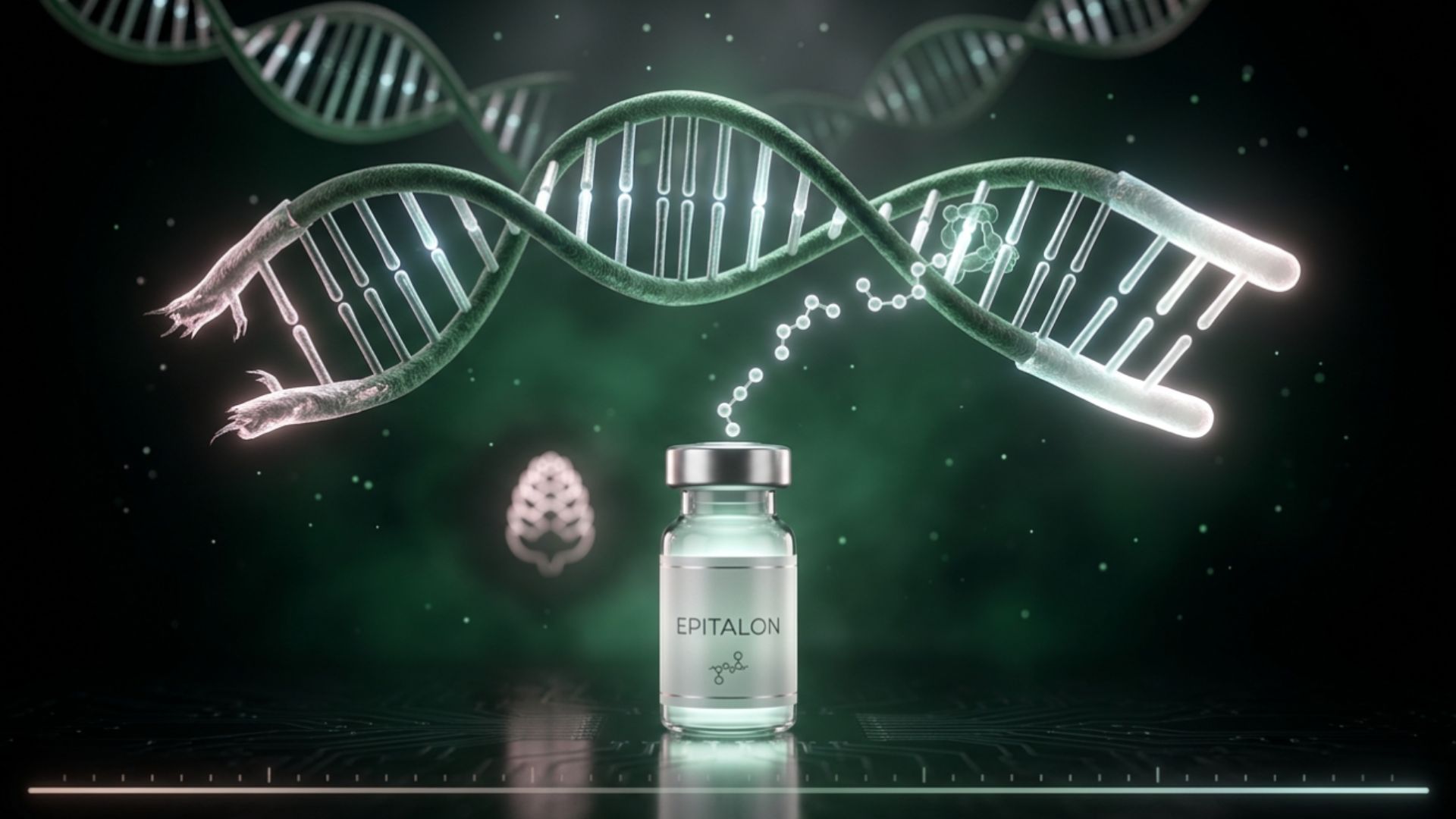
Telomerase is the enzyme that rebuilds these caps. In most adult cells, telomerase is silenced. Epitalon’s proposed mechanism involves:
- Binding to cell surface receptors.
- Triggering cascades that activate transcription factors like c-Myc and Sp1.
- Upregulating the hTERT gene (the catalytic subunit of telomerase).
- Stabilizing or elongating telomeres in normal healthy cells.
Quality of Evidence: A GRADE-Style Assessment
Using parameters similar to the GRADE (Grading of Recommendations Assessment, Development, and Evaluation) framework, Epitalon scores as follows:
- Overall Evidence Level: VERY LOW.
- Study Design Baseline: Mostly in vitro (petri dish) and small animal models. Human trials are primarily observational and lack rigorous double-blinding.
- Risk of Bias: High. Prominent studies lack randomization details and independent Western replication.
- Indirectness: High. Telomere elongation in a lab setting does not automatically equate to clinical lifespan extension in a living human.
Epitalon and Cancer: A Critical Warning
⚠️ IMPORTANT: Epitalon activates telomerase — the same enzyme hijacked by over 85% of human cancers to achieve unlimited replication.
Recent 2025 data investigating human breast cancer cell lines revealed that Epitalon could trigger the ALT (Alternative Lengthening of Telomeres) pathway. This is a highly aggressive mechanism some cancers use to survive indefinitely. While Epitalon helps healthy cells, it may simultaneously “supercharge” malignant cells. Anyone with a history of cancer or active malignancy should avoid this peptide.
Epitalon Peptide Benefits
Beyond telomeres, research points to several potential (though not clinically proven) benefits:
- Circadian Rhythm: Upregulates AANAT, the enzyme responsible for natural melatonin synthesis. This may improve sleep quality and wake-sleep cycles without the “feedback loop” suppression caused by taking melatonin supplements.
- Antioxidant Properties: Reported increases in superoxide dismutase (SOD) and catalase activity.
- Immune Health: Signals suggest a normalization of the CD4+/CD8+ T-cell ratio, potentially reversing “immunosenescence.”
Dosage, Protocol, and Administration
Note: The following is compiled from historical research and is not a medical recommendation.
| Administration Route | Typical Dose Range | Cycle Duration | Notes |
| Subcutaneous Injection | 5–10 mg/day | 10–20 days | Most cited; requires bacteriostatic water. |
| Nasal Spray | 1–3 mg/day | 10–20 days | Convenient but lower absorption data. |
| Oral (Amidate) | Not well-established | — | Theoretically protected from gut enzymes. |
The “15-Minute” Caveat: Epitalon has an extremely short plasma half-life (approx. 15–20 minutes). The efficacy of short “burst” cycles relies on the theory of “epigenetic momentum”—the hope that a short activation period permanently alters gene expression.
Vendor Safety Check: Avoiding Fakes
The peptide market is unregulated. A 2025 U.S. Pharmacopeia analysis found that a significant portion of online products contained incorrect sequences or dangerous endotoxin levels.
Evaluation Checklist:
- HPLC Purity: Must be
- ≥
- ≥
- 98%.
- Third-Party Verification: Look for CoAs (Certificates of Analysis) from reputable labs like MZ Biolabs or Janoshik.
- Endotoxin Testing: Levels must be < 5 EU/mg to avoid fever or systemic inflammation.
- Mass Spectrometry: Confirms the amino acid sequence is actually Epitalon.
Epitalon vs. Pinealon
| Parameter | Epitalon | Pinealon |
| Sequence | Ala-Glu-Asp-Gly | Glu-Asp-Arg |
| Primary Target | Endocrine / Systemic Aging | Central Nervous System |
| Primary Goal | Telomere maintenance | Memory / Neuroprotection |
| Cancer Risk | Higher (Telomerase activation) | Lower (No telomerase link) |
Peptide Stacking Risks
Stacking Epitalon with other peptides can multiply safety risks:
- Epitalon + BPC-157: BPC-157 promotes angiogenesis (new blood vessels), while Epitalon promotes replication. If an undetected tumor exists, this stack provides it with both a blood supply and unlimited growth capacity—an oncological nightmare scenario.
- Epitalon + Thymosin Alpha-1: May lead to hyper-stimulation of the immune system, potentially triggering autoimmune flares in susceptible individuals.
Frequently Asked Questions
How long before I see results?
Anti-aging is not a “feeling.” Objective evaluation requires qPCR telomere length testing or DNA Methylation “clocks” (e.g., TruAge) performed before and 3–6 months after a cycle.
What bloodwork is needed?
A responsible baseline includes a Comprehensive Metabolic Panel (CMP), a Complete Blood Count (CBC), and age-appropriate cancer screenings (e.g., PSA or mammograms).
What is the cost?
A full protocol including the peptide and required lab testing (to ensure it is actually working) often exceeds
800–
800–
1,200 per cycle.
Related Articles
Updated: May 30, 2026 Reviewed by: Rusty Ryan, Lead Formulation Specialist at Iron Peptides. “Most people researching
- June 23, 2026

Last Updated: May 30, 2026 Medically Reviewed by: Dr. Sarah Mitchell, MD, Board-Certified Immunologist Medical Disclaimer: This
- June 22, 2026

MEDICAL DISCLAIMER: This article is for educational and informational purposes only. It does not constitute medical advice,
- June 21, 2026