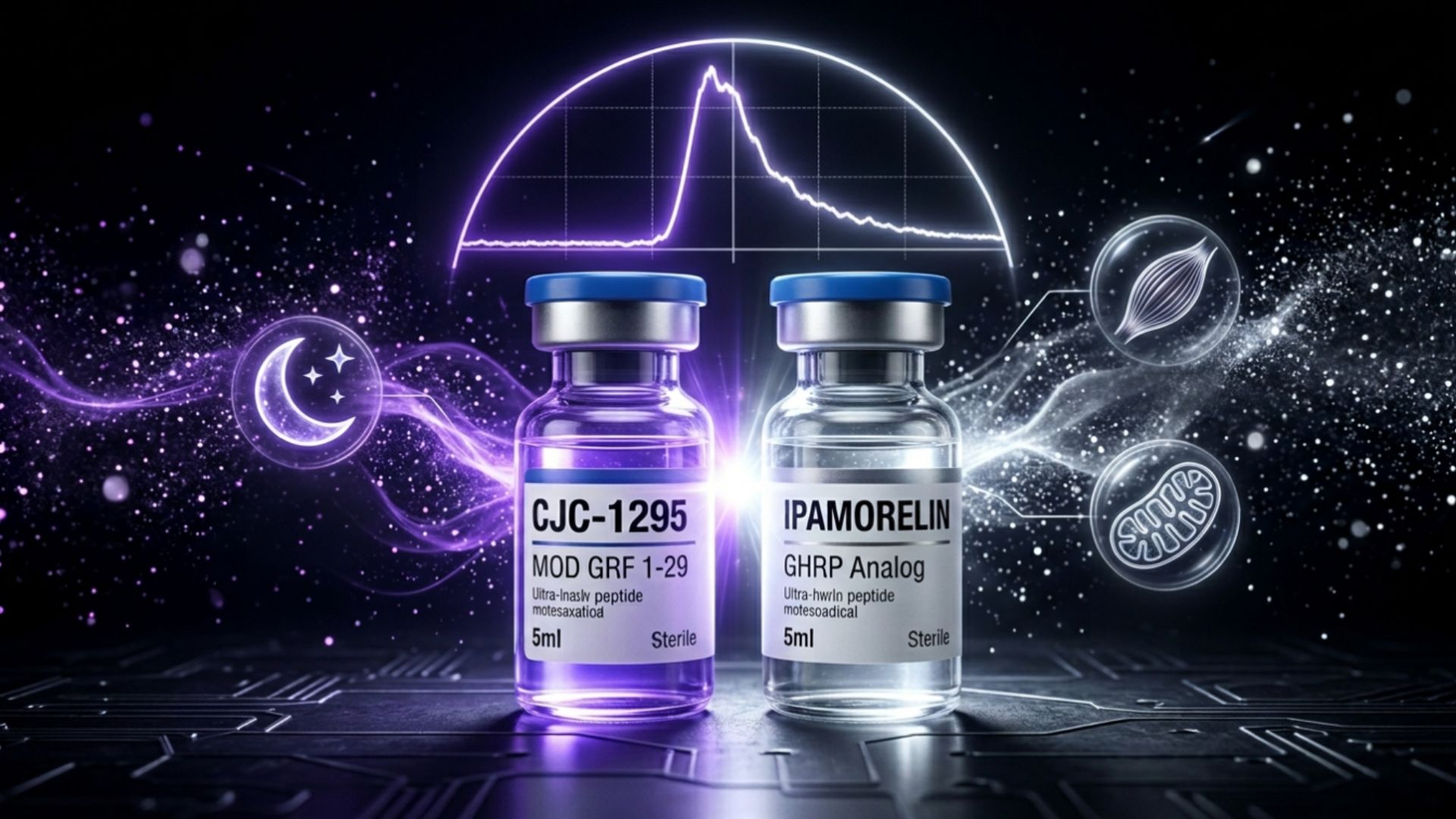
Ask a hundred researchers which growth hormone peptide protocol they keep coming back to, and the same answer keeps surfacing: CJC 1295 paired with Ipamorelin. Not because it’s the newest thing – it isn’t. Because it works consistently, the side-effect profile is genuinely clean, and the mechanism makes sense once you understand what each compound actually does.
This guide is the complete breakdown. How the stack works, the DAC vs no-DAC decision that trips up beginners, exact CJC-1295 Ipamorelin dosage guidance, the math behind reconstitution and dosing, what realistic results look like across a full cycle, and how to think through the safety profile honestly.
How CJC-1295 and Ipamorelin Work Together
The reason CJC 1295 Ipamorelin is considered the gold-standard GH stack comes down to mechanism complementarity. These two compounds work on the same output – pituitary growth hormone release – through completely different entry points.
CJC-1295 is a GHRH analog. GHRH (growth hormone-releasing hormone) is the signal the hypothalamus sends to the pituitary to stimulate GH production and release. CJC-1295 mimics and extends that signal – it tells the pituitary to produce more GH per pulse and keeps the signal active longer than endogenous GHRH would on its own. Teichman et al.’s human study documented dose-dependent 2- to 10-fold increases in mean GH plasma concentrations following CJC-1295 administration, with sustained IGF-1 elevation lasting 9-11 days at higher doses.
Ipamorelin CJC 1295 pairing adds the GHRP side. Where CJC-1295 amplifies the signal, Ipamorelin pulls the trigger – it activates ghrelin receptors in the pituitary to initiate GH pulses. Raun et al.’s landmark 1998 study in the European Journal of Endocrinology characterized Ipamorelin as the first selective GH secretagogue, demonstrating that it produces robust GH pulses without the cortisol, prolactin, or ACTH elevation seen with earlier GHRPs like GHRP-2 and GHRP-6.
Together, CJC-1295 increases the amount of GH released per pulse, and Ipamorelin increases the frequency and initiates those pulses. The combination produces significantly greater GH output than either compound achieves alone – while maintaining the clean hormonal profile that makes the stack practical for extended cycles.
CJC-1295 DAC vs No DAC: Which Version Should You Use?
CJC 1295 DAC vs CJC 1295 no DAC is the most important decision in this protocol, and it has a clear answer for most applications.
DAC stands for Drug Affinity Complex – a chemical modification that extends CJC-1295’s half-life from approximately 30 minutes to 6-8 days. With CJC 1295 DAC, you inject once or twice weekly and maintain persistently elevated baseline GH levels between doses. Convenient, but the GH elevation is continuous rather than pulsatile.
CJC-1295 without DAC (also called Mod GRF 1-29) has a short natural half-life. Injected alongside Ipamorelin, it produces a sharp, clean GH pulse that peaks and clears within hours. More injections are required (typically 1-3 times daily), but the pulsatile pattern more closely mimics the body’s natural GH release.
Van Cauter, Plat & Copinschi’s research on sleep documented the relationship between pulsatile GH secretion and sleep architecture: the largest GH pulse of the day occurs during the first few hours of slow-wave sleep, and it’s a discrete pulse, not a continuous elevation. This is the physiological basis for the no-DAC preference in Ipamorelin stacks: you’re amplifying a pulse that already exists, not creating a constant hormonal background.
Why Most Researchers Choose No-DAC for This Stack
CJC-1295 Ipamorelin protocols almost universally default to no-DAC for the synergy reason: the GHRH + GHRP combination is designed to produce clean, timed pulses. Pairing Ipamorelin with CJC 1295 no DAC lets you time those pulses deliberately – before bed, post-workout, or both – which is the entire strategic advantage of this stack.
Continuous GH elevation from DAC can blunt receptor sensitivity over time and may interfere with insulin signaling in ways that pulsatile release doesn’t. The extra injection frequency of no-DAC is a small operational cost for a meaningful improvement in physiological outcomes in most protocols.
DAC has a legitimate use case: researchers focused on specific recovery applications where sustained IGF-1 elevation matters more than pulsatile GH release, or those who can’t commit to multiple daily injections. But for most people running this stack for recovery, body composition, or anti-aging, no-DAC is the correct choice.
CJC-1295 Ipamorelin Dosage: How Much and How Often
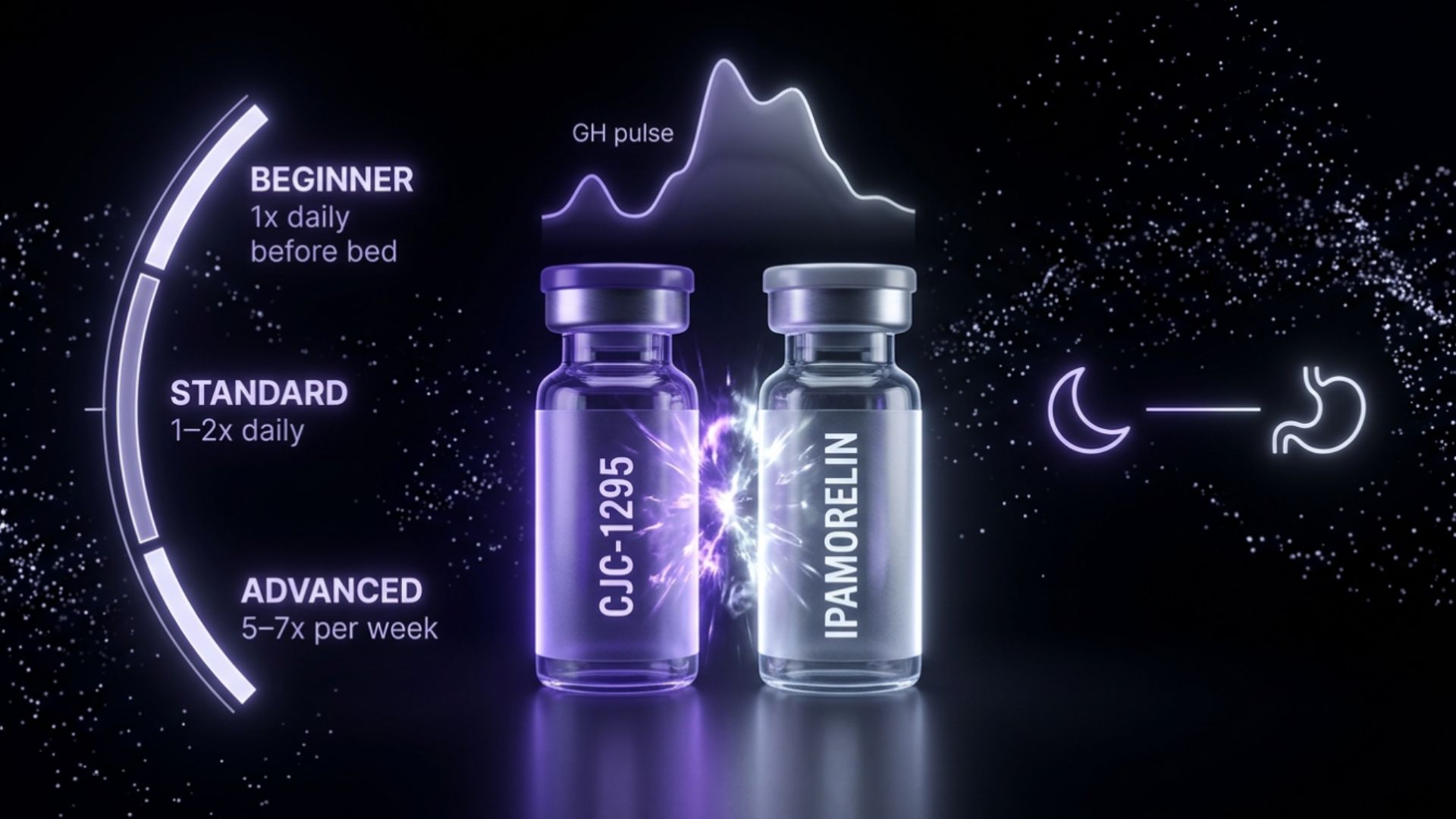
CJC-1295 Ipamorelin dosage in standard research protocols: 100mcg of each compound per injection, administered subcutaneously 1-3 times daily.
The most important injection is before bed. This is non-negotiable in serious protocols – you’re amplifying the natural GH surge that occurs during slow-wave sleep, which is the highest-output GH window the body has. Skip this dose, and you’re losing the most valuable application of the stack.
The second most useful timing is post-workout. Training creates a GH-sensitized environment, and a CJC 1295 Ipamorelin dosage injection within 30-60 minutes of finishing capitalizes on that window for recovery and protein synthesis.
A third morning dose is optional for advanced protocols targeting accelerated body composition changes or more aggressive anti-aging effects.
For CJC 1295 DAC users: 1-2mg once or twice weekly, paired with Ipamorelin at 100-300mcg taken 1-3 times daily on their normal schedule. The Ipamorelin dosing cadence stays the same regardless of which CJC version you’re running.
Ipamorelin dosage shouldn’t be the variable you reach for first when optimizing the protocol. Timing matters more than dose escalation. The pituitary can only produce so much GH per pulse – saturation is real, and doubling the dose doesn’t double the output.
Standard cycle: 8-12 weeks on, 4 weeks off. This preserves pituitary sensitivity and provides a genuine assessment window into what the protocol is actually producing.
CJC-1295 Ipamorelin Dosage Calculator: Getting the Math Right
The CJC-1295 Ipamorelin dosage calculator logic is the same as any peptide: vial concentration determines draw volume.
Example with our 5mg vials of each compound:
Reconstitute each with 3mL of bacteriostatic water → 2,500mcg/mL per vial. To deliver 100mcg of each compound, draw 0.04mL (4 units on an insulin syringe) from each vial. If you’re combining both into a single injection – which many researchers do for convenience – draw 4 units from each into the same syringe: 8 units total, delivering 100mcg CJC-1295 + 100mcg Ipamorelin per injection.
Our Peptide Calculator on the product page handles this automatically – enter your vial size, reconstitution volume, and target dose, and it outputs the draw volume. It eliminates the most common error in peptide protocols: miscalculating concentration and systematically under- or over-dosing without realizing it.
CJC-1295 Ipamorelin bodybuilding dosage protocols sometimes push to 200-300mcg per injection, taken 2-3 times daily, particularly during cutting phases or periods focused on body recomposition. The additional dose can modestly increase GH output, but the returns diminish above 200mcg per injection due to pituitary saturation. More frequency is more valuable than more milligrams.
CJC-1295 Side Effects and Ipamorelin Safety Profile
CJC-1295 Ipamorelin side effects are minimal compared to older GHRP protocols, which is a major reason this stack has remained relevant despite newer compounds entering the space.
Most common: brief water retention in the first 1-2 weeks as GH levels rise. A “head rush” or mild flushing sensation shortly after injection – this is a hallmark of GH release and typically passes within 20-30 minutes. Injection site irritation is standard for any SubQ protocol. Some users report mild fatigue in the first week.
CJC 1295 side effects that warrant attention: tingling or numbness in the extremities, particularly in the hands, if running at the high end of dosing for extended periods. This is an early carpal tunnel-like symptom associated with sustained GH elevation and resolves by lowering the dose or taking a break. Minor changes in fasting insulin sensitivity can occur with longer cycles – manageable but worth monitoring.
What you won’t see: cortisol spikes, prolactin elevation, or significant hunger increase. That’s the Ipamorelin selectivity advantage documented in the Raun 1998 paper – it was specifically designed to avoid the hormonal noise that made older GHRPs less practical.
CJC-1295 Ipamorelin Before and After: Realistic Expected Results
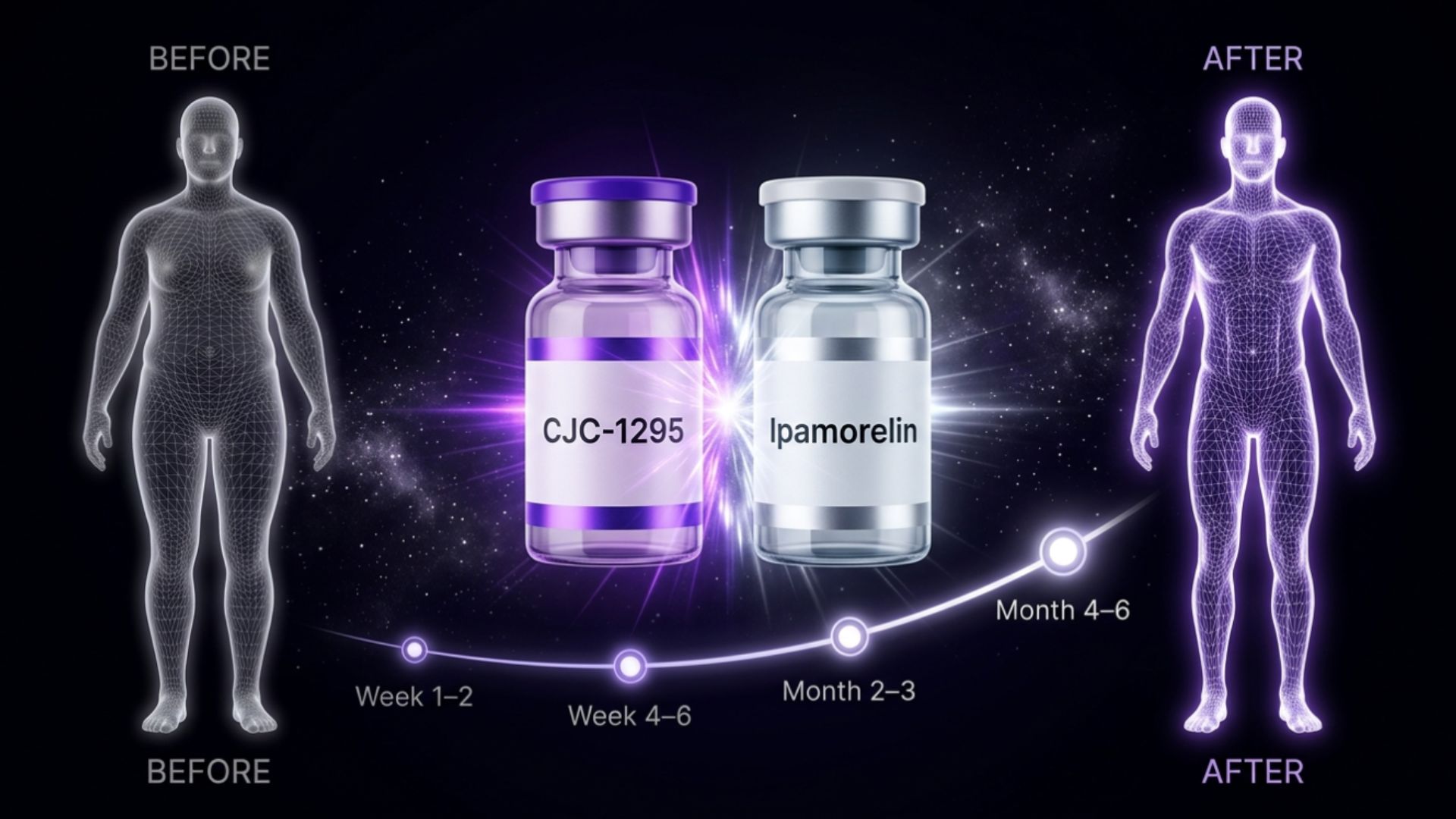
CJC 1295 Ipamorelin before and after results follow a predictable timeline, and setting accurate expectations upfront makes the difference between a successful cycle and a disappointing one.
- Weeks 1-2: sleep quality is usually the first change noticed. Deeper sleep, more vivid dreams, and improved morning energy. This makes sense mechanistically – you’re amplifying the GH pulse that drives slow-wave sleep recovery.
- Weeks 3-6: recovery improvements become tangible. Muscle soreness reduces faster. Joint discomfort that was background noise starts quieting. Some users notice early improvements in skin texture.
- Weeks 6-12: body composition changes emerge gradually. Visceral fat reduction over time, modest lean tissue improvements in users who train consistently, and improved skin elasticity. CJC-1295 Ipamorelin results in this window are cumulative – they build on each other rather than arriving suddenly.
What doesn’t happen: dramatic overnight transformations. This stack works with the body’s natural systems rather than overriding them. The changes are real and consistent, but they look like gradual improvements over 8-12 weeks, not before-and-after photos from week two.
Final Thoughts: Is CJC-1295 Ipamorelin the Right Stack for You?
CJC-1295 Ipamorelin has maintained its position as the benchmark GH peptide protocol because the core case hasn’t changed: clean GH stimulation, minimal side effects, and consistent outcomes across diverse goals.
The CJC-1295 Ipamorelin dosage approach – 100mcg of each compound per injection, 1-3x daily with the bedtime dose as the anchor – is where to start. Scale from there based on response, not assumption. The CJC-1295 Ipamorelin side effects profile is manageable and well-characterized. And CJC 1295 Ipamorelin before and after results, when the protocol is followed consistently and sourced correctly, reliably reflect what the published research and the research community report.
We carry both CJC-1295 No DAC and CJC-1295 with DAC, as well as Ipamorelin, all batch-tested by Freedom Diagnostics with lot-specific COAs available before purchase. The pre-made CJC-1295/Ipamorelin blend is also available for researchers who want a single-vial solution. Reconstitution volume and draw math are on the product page calculator.