

Is NAD+ a Peptide?
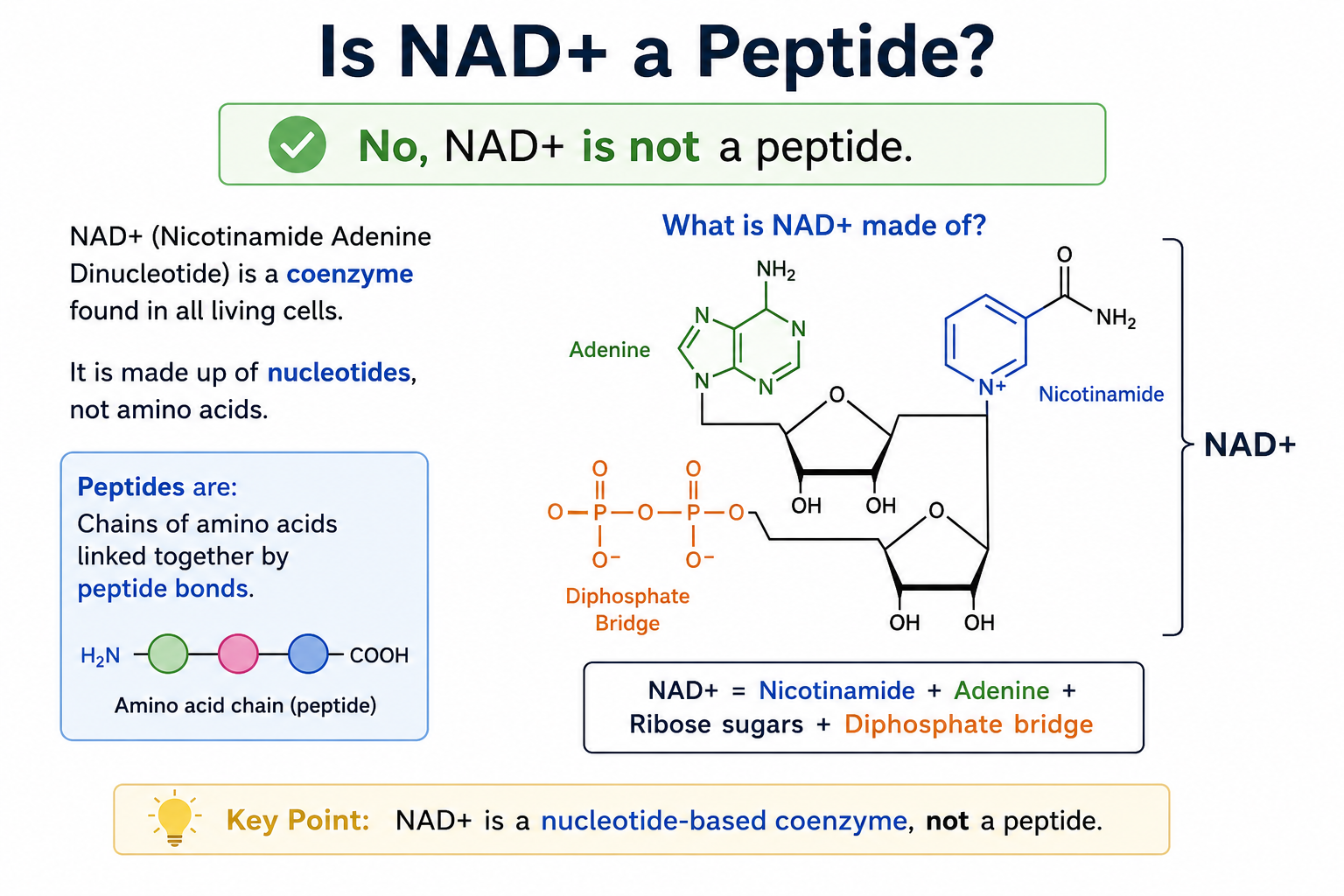
No — NAD+ (nicotinamide adenine dinucleotide) is not a peptide. It’s a coenzyme built from two linked nucleotides, not a chain of amino acids. The two get grouped together constantly in the research compound space because they’re often sold side by side — you’ll find NAD+ listed right next to peptides like BPC-157 or Tesamorelin in the same research catalog — but structurally and functionally, NAD+ belongs to an entirely different molecular family. This article breaks down exactly what NAD+ is, why the confusion exists, and how it compares to true peptides.
What NAD+ Actually Is
NAD+ is a dinucleotide — a molecule made of two nucleotides joined together through their phosphate groups. Each nucleotide consists of a nitrogenous base (nicotinamide on one side, adenine on the other), a ribose sugar, and a phosphate group. This structure is chemically closer to a building block of DNA/RNA than to a protein fragment.
Functionally, NAD+ acts as a coenzyme. It shuttles electrons during cellular redox reactions, playing a central role in converting nutrients into usable cellular energy (ATP) and supporting processes like DNA repair and sirtuin activation. It exists in two interconvertible forms — the oxidized NAD+ and the reduced NADH — that cycle constantly during metabolism.
Peptides, by contrast, are short chains of amino acids linked by peptide bonds. A peptide’s identity and function come from its specific amino acid sequence — the order in which building blocks like glycine, lysine, or proline are strung together. That’s a fundamentally different kind of chemistry from NAD+’s two-nucleotide structure.
Why NAD+ Gets Confused With Peptides
The mix-up is understandable, and it shows up constantly in search behavior — the keyword “nad peptide” gets tens of thousands of monthly searches. A few reasons the two get lumped together:
- Retailers sell them in the same catalogs. Research peptide suppliers commonly carry NAD+ alongside peptides like BPC-157, CJC-1295, and TB-500, since the customer base and use cases overlap.
- They’re both biomolecules studied for cellular repair and longevity. NAD+ and many peptides are researched in overlapping contexts — mitochondrial function, aging, recovery — so the subject matter blends together in casual conversation.
- Both come as lyophilized powders. NAD+ and peptides are frequently supplied in the same vial format, reconstituted with bacteriostatic water the same way, which reinforces the impression that they’re the same category of compound.
- The word “peptide” has become shorthand. In research-compound communities, “peptide” is often used loosely to mean “lab compound” in general, even when the molecule in question isn’t a peptide at all.
NAD+ vs. Peptides: Key Differences
| NAD+ | Peptides | |
| Molecular class | Dinucleotide (two nucleotides joined by a pyrophosphate bond) | Short chain of amino acids joined by peptide bonds |
| Building blocks | Nicotinamide + adenine + two ribose sugars + two phosphate groups | Amino acids (e.g., glycine, proline, lysine) |
| Primary role | Coenzyme for redox reactions and enzymatic energy transfer | Signaling molecules, structural components, enzyme substrates |
| Origin in the body | Synthesized from vitamin B3 (niacin/nicotinamide) precursors | Synthesized via ribosomal or non-ribosomal amino acid assembly |
| Examples | NAD+, NADH, NADP+ | BPC-157, TB-500, Tesamorelin, GHK-Cu |
Why NAD+ and Peptides Are Often Sold and Stacked Together
Even though NAD+ isn’t a peptide, it’s frequently studied alongside them because the two can support overlapping cellular pathways — NAD+ underpins the energy metabolism that peptide-driven repair and signaling processes rely on. That’s part of why a supplier like Iron Peptides carries NAD+ in both vial and nasal spray formats within the same research catalog as its peptide lineup — the compounds are commonly researched together, even though they belong to different molecular classes.
Frequently Asked Questions
Is NAD+ the same as a peptide bond?
No. A peptide bond is the specific chemical bond linking amino acids together in a peptide chain. NAD+ contains no peptide bonds — its two halves are joined by a pyrophosphate linkage between two phosphate groups instead.
Is NAD+ a protein?
No. Proteins are large, folded structures built from many peptide-bonded amino acids. NAD+ is a small dinucleotide coenzyme, unrelated in structure to proteins or peptides.
Why is NAD+ sold alongside peptides then?
Because suppliers and researchers group compounds by use case and format rather than strict molecular classification. NAD+ ships as a lyophilized vial or spray just like many peptides, and it’s studied in the same cellular-health and longevity research space, so it ends up in the same catalogs.
Is NADH a peptide either?
No. NADH is simply the reduced form of NAD+ — same dinucleotide backbone, different electron-carrying state. Neither form is a peptide.
Research Use Disclaimer: This article is for informational and educational purposes only. NAD+ and all products referenced are intended strictly for in-vitro laboratory research and are not approved for human or animal consumption. Nothing in this article constitutes medical advice.
Related Articles

Correct storage is what separates a stable, effective batch of MT2 nasal spray from one that has
- September 1, 2026

Proper storage is essential for preserving the integrity of VIP nasal spray, a compounded formulation of Vasoactive
- August 31, 2026

Proper storage is one of the most overlooked variables in peptide research, and P21 nasal spray is
- August 31, 2026