


Selank is a synthetic tuftsin analog studied primarily via intranasal administration, and like most research peptides, its stability depends heavily on how it’s stored before and after reconstitution. Improper storage of selank nasal spray is one of the most common reasons researchers see inconsistent results between doses. This guide covers correct storage conditions for both the lyophilized powder and the reconstituted spray, along with signs that a solution has degraded.
Why Storage Affects Selank Stability
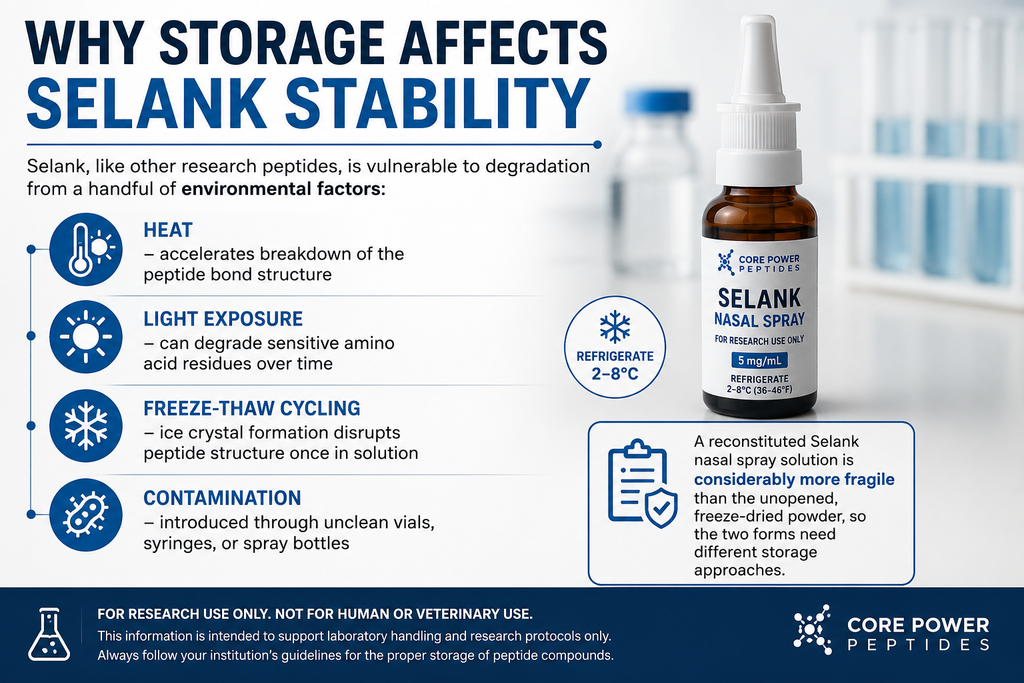
Selank, like other research peptides, is vulnerable to degradation from a handful of environmental factors:
- Heat — accelerates breakdown of the peptide bond structure
- Light exposure — can degrade sensitive amino acid residues over time
- Freeze-thaw cycling — ice crystal formation disrupts peptide structure once in solution
- Contamination — introduced through unclean vials, syringes, or spray bottles
A reconstituted Selank nasal spray solution is considerably more fragile than the unopened, freeze-dried powder, so the two forms need different storage approaches.
Storing Lyophilized Selank Powder
- Refrigerated (2–8°C): Suitable for shorter-term storage, typically stable for the duration noted on the certificate of analysis.
- Frozen (-20°C or below): Best for long-term storage before reconstitution — freezing does not damage the peptide in its lyophilized state.
- Keep sealed and away from light: Store the vial in its original packaging, away from windows or direct light sources.
Avoid leaving the powder at room temperature for extended periods, and avoid storing it in a refrigerator door where temperature fluctuates each time it’s opened.
Storing Reconstituted Selank Nasal Spray
- Refrigerate immediately after mixing. A reconstituted Selank solution should stay at 2–8°C at all times when not actively in use.
- Expect a 2–4 week usable window. Most research protocols treat reconstituted Selank as stable for roughly 2–4 weeks under refrigeration, depending on the diluent and concentration used.
- Never freeze the reconstituted solution. Freeze-thaw cycles are far more damaging to the mixed spray than to the dry powder.
- Keep the spray bottle upright and capped between uses to limit contamination and evaporation.
- Label the bottle with the reconstitution date. This makes it easy to track when the solution is approaching the end of its stability window.
Signs Selank Nasal Spray Has Degraded
A Selank solution that has turned cloudy, changed color, or developed visible particulate should no longer be used for research purposes. The same applies to any solution that has been left unrefrigerated for an extended stretch, or one that has gone through multiple freeze-thaw cycles after reconstitution.
Quick Storage Reference
| Form | Recommended Storage | Typical Stability Window |
| Lyophilized powder | Freezer or refrigerator, dark, sealed | 12–24 months* |
| Reconstituted nasal spray | Refrigerator only (2–8°C) | 2–4 weeks |
*Refer to the certificate of analysis provided with your specific batch for exact stability data.
Frequently Asked Questions
How should Selank nasal spray be stored?
Reconstituted Selank should be kept refrigerated at 2–8°C at all times between uses. Unreconstituted lyophilized powder can be refrigerated or frozen for longer-term storage.
Can Selank nasal spray be frozen after reconstitution?
No — freezing a reconstituted Selank solution is not recommended, as freeze-thaw cycles can degrade the peptide. Freezing is appropriate only for the unmixed, lyophilized powder.
How long does Selank nasal spray last once mixed?
Most research protocols treat a reconstituted Selank solution as stable for approximately 2–4 weeks when refrigerated, though this depends on diluent and concentration.
What happens if Selank nasal spray isn’t refrigerated?
Extended exposure to room temperature or heat accelerates degradation of the peptide, which can reduce the solution’s consistency and reliability for research use.
This article is provided for research and informational purposes only. Selank and related compounds discussed here are sold strictly for laboratory research use and are not intended for human consumption, diagnostic, or therapeutic use. Always consult your institution’s research protocols for proper handling of peptide compounds. For research-grade Selank and other peptides, visit Iron Peptides.


