

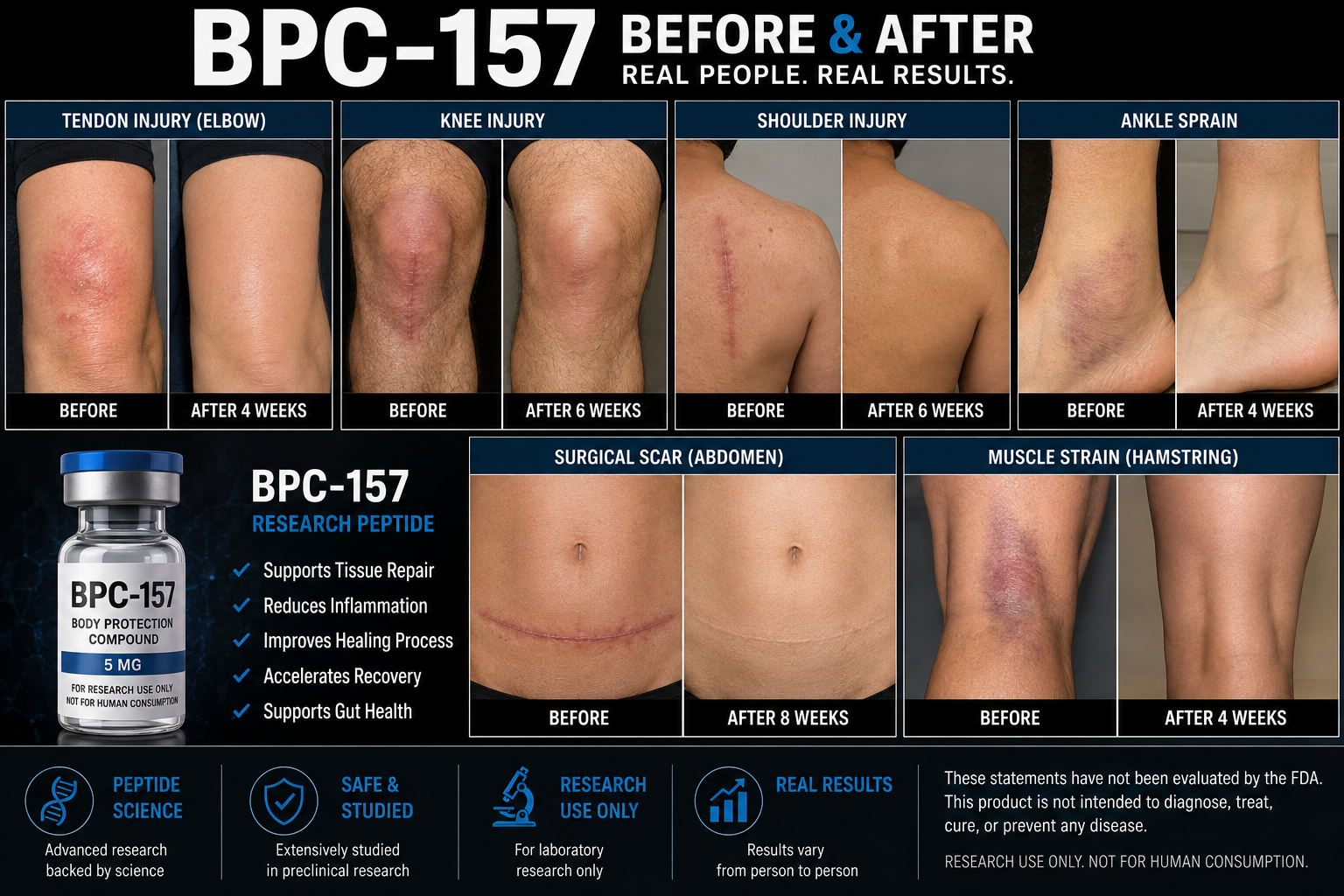
BPC-157 before and after searches sit on a genuinely large, active documentation base — real Reddit recovery logs, a widely-viewed YouTube deep-dive with over 26,000 monthly visits, and peer-reviewed literature reviews all rank directly on page one. BPC-157 is a synthetic pentadecapeptide studied for its role in angiogenesis and tissue repair, and its before-and-after content spans everything from injury recovery to muscle growth to skin. This guide covers the realistic timeline, what the muscle-growth claims actually support, and real reported experiences, for research purposes only. BPC-157 research protocols referenced throughout are for laboratory use only.
BPC-157 Before and After: The Recovery Timeline
Recovery timelines vary meaningfully by injury type, but research subjects and structured protocols consistently describe a three-phase pattern: early changes (reduced pain, subtle inflammation reduction) within the first 1-2 weeks, more substantial healing markers developing weeks 3-6, and continued improvement in tissue quality extending out to weeks 8-12 for more significant soft-tissue injuries. This mirrors the general finding in the peer-reviewed literature — a narrative review on musculoskeletal healing frames BPC-157 as a genuinely promising research compound while also noting the evidence base is still narrower than the enthusiasm around it would suggest.
BPC-157 Before and After Muscle Growth: What’s Actually Supported
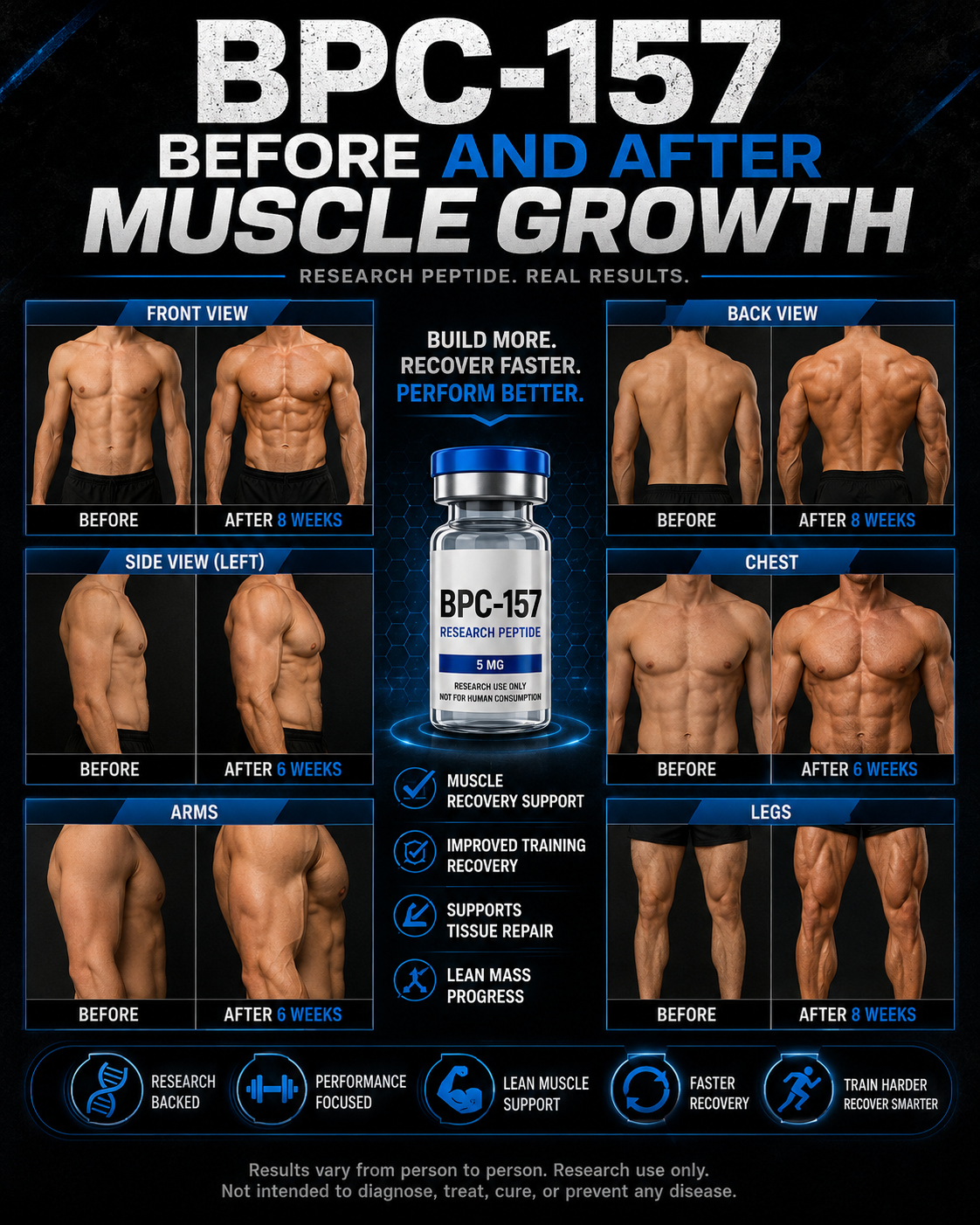
This is one of the more search-active but least precisely supported claims in the BPC-157 cluster. BPC-157’s studied mechanism doesn’t function as an anabolic or muscle-building compound in the way that term usually implies — its research support centers on angiogenesis, growth-factor modulation, and accelerated recovery from training-related micro-damage. In practice, this means the “muscle growth” reported in before-and-after content is more accurately described as improved recovery capacity allowing for more consistent, less interrupted training, rather than a direct hypertrophy mechanism. Research reviewed in PMC specifically examined BPC-157’s interaction with the growth hormone-IGF-1 axis, which is the more precise mechanistic story behind these reports than a simple “it builds muscle” framing.
Is It Good to Take BPC-157 Every Day?
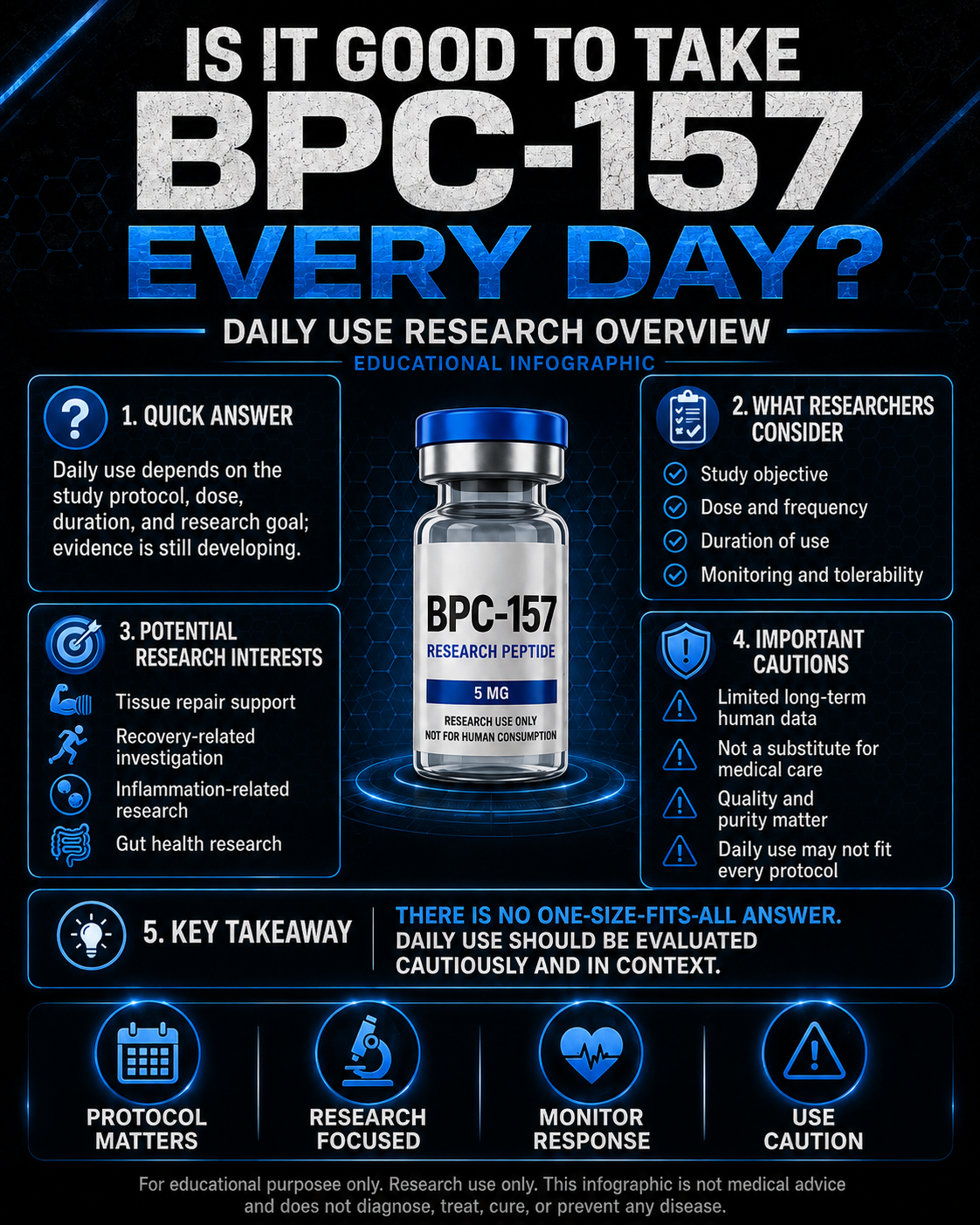
Most structured research protocols use defined cycles rather than continuous indefinite daily use — commonly 4-8 weeks on, followed by a rest period. There isn’t strong long-term human safety data supporting extended continuous daily use, which is a genuine gap in the literature rather than a settled non-issue, and the more cautious peer-reviewed sources frame this explicitly as an open question rather than a resolved one.
Is BPC-157 Hard on the Kidneys?
This question shows up frequently enough in search behavior to address directly. The available research doesn’t show strong evidence of kidney-specific toxicity at studied research doses, but the human trial base broadly is still limited, meaning any organ-specific long-term safety claim — positive or negative — should be treated as provisional rather than settled. This is exactly the kind of question best directed to a licensed provider if it applies to a specific research protocol.
Will BPC-157 Regrow Hair?
Similar to GHK-Cu and TB-500 in the Glow/Klow blends, BPC-157’s hair-related claims are anecdotal rather than clinically established. Its primary studied mechanism is tissue and gut-related repair, not follicle-specific regeneration, and any hair-related reports circulating online should be read as individual anecdotes rather than an established use case.
Real BPC-157 Before and After Examples
- r/bpc_157 — “I’ve been taking bpc-157 for 2 months and here’s what I’ve found” — a genuine 2-month self-report in a dedicated subreddit
- r/climbharder — “My experience case study recovering from an A2 tear + A1 strain with BPC…” — a detailed, injury-specific case study relevant to the tendon-recovery use case
- r/crossfit — “Thoughts on BPC-157?” — an athletic community discussion thread
- “The before and afters at the end will blow you away” — ranking directly in position 1 for the core keyword
- “I’m sure BPC157 has worked for a lot of people out there. But it’s worth asking…” — a more skeptical, critically-framed post worth reading precisely because it questions rather than assumes
- Hip Replacement Support Group — “Anyone use peptides BPC157 & TB500 before/after surgery?” — real post-surgical discussion
YouTube
- “Peptide BPC-157 – Does It Work? Breaking Down…” — a high-traffic, critically-framed breakdown video (26,600+ monthly visits), worth watching specifically because it examines the evidence rather than just asserting results
Why Sourcing Matters
A meaningful share of inconsistent BPC-157 before-and-after reports trace back to unverified research material rather than the underlying mechanism failing — a pattern consistent across nearly every peptide covered in this research series. Given how much of BPC-157’s real-world documentation involves injury-specific recovery tracking over months, an unverified or underdosed batch can be genuinely difficult to distinguish from a slow natural healing process without a reliable baseline. Working with a supplier that provides a batch-specific Certificate of Analysis removes that variable from the equation.
Frequently Asked Questions
What is the BPC-157 before and after timeline?
Early changes are often reported within 1-2 weeks, more substantial healing markers by weeks 3-6, and continued tissue quality improvement out to weeks 8-12 for more significant injuries.
Does BPC-157 cause muscle growth?
Not through a direct anabolic mechanism — its research support centers on angiogenesis and recovery capacity, meaning reported “muscle growth” is more accurately improved recovery allowing more consistent training.
Is it good to take BPC-157 every day?
Most research protocols use defined 4-8 week cycles rather than continuous daily use, given limited long-term human safety data on extended use.
Will BPC-157 regrow hair?
Hair-related claims are anecdotal rather than clinically established; BPC-157’s studied mechanism centers on tissue and gut repair, not follicle regeneration.
Final Take for Researchers
BPC-157’s before-and-after documentation is genuinely extensive — real Reddit recovery logs, critically-framed YouTube reviews, and peer-reviewed literature all point to a consistent recovery-focused timeline rather than the more dramatic “muscle growth” framing some search behavior implies. The realistic story is improved recovery capacity and tissue repair support over a multi-week timeline, with several open questions (daily use safety, organ-specific effects) still genuinely unresolved in the literature rather than settled. Explore the full peptide research catalog at Iron Peptides for COA-verified BPC-157 and related tissue-repair compounds.
This article is for informational and educational purposes only. BPC-157 and all products referenced are intended strictly for laboratory research use and are not approved for human consumption, diagnosis, treatment, or prevention of any disease.


