

Survodutide vs Tirzepatide: Dual incretin agonists have become one of the most active areas in metabolic peptide research, and two compounds keep coming up in researcher discussions: survodutide and tirzepatide. Both are studied as dual GLP-1/GIP receptor agonists, but they differ in trial stage, receptor activity profile, and the body of published data behind them. For anyone building a research protocol around incretin pathways, understanding these differences matters before selecting a compound to study.
Two Compounds, Two Stages of Development
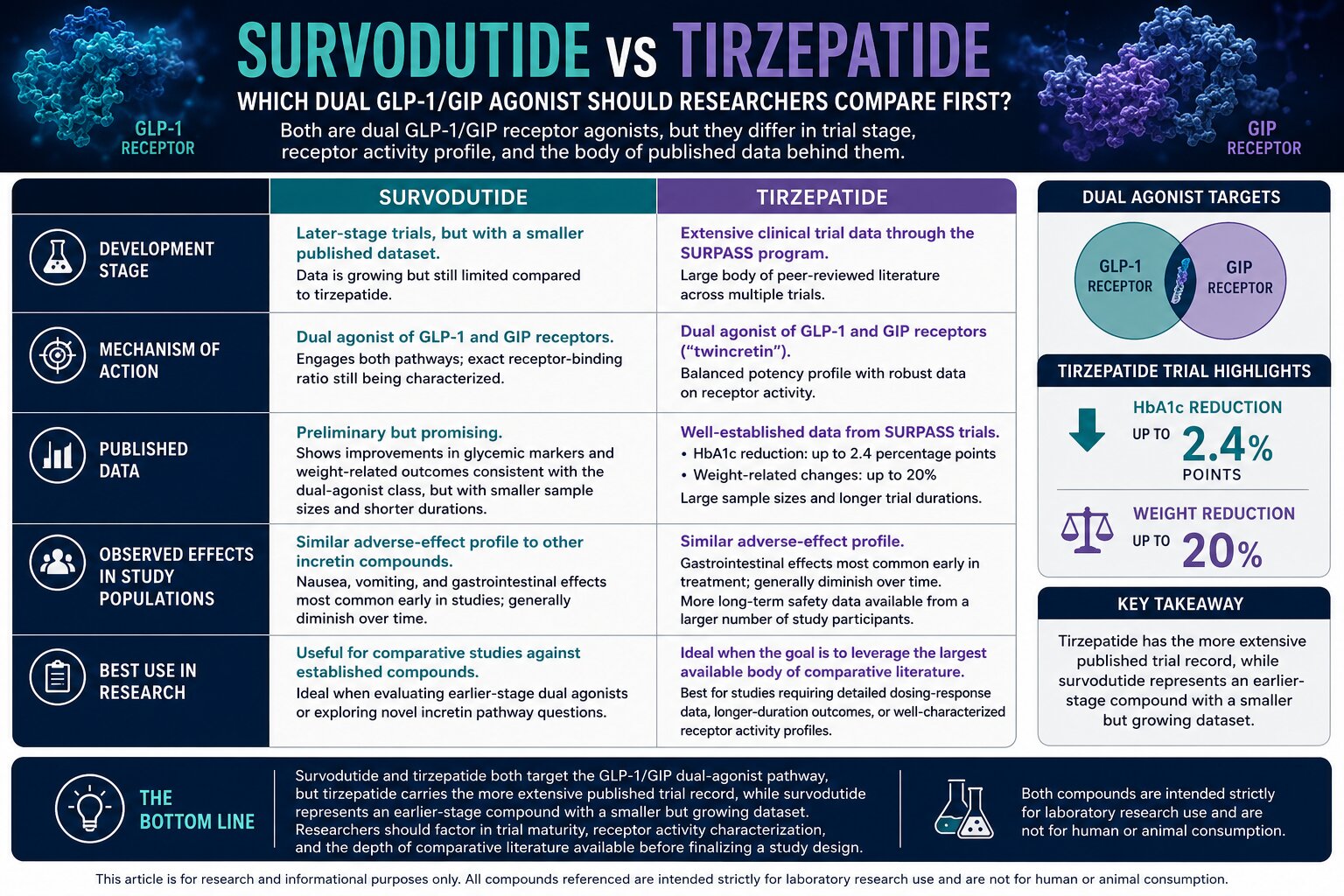
Survodutide is further along in trial development than many newer GLP-1/GIP candidates, but it remains behind tirzepatide in terms of published, peer-reviewed volume. Tirzepatide has been studied extensively through the SURPASS trial program, generating a large dataset on receptor activity, glycemic markers, and body-weight-related endpoints in study populations. Survodutide’s dataset is smaller and still expanding, which means researchers comparing the two are often comparing a well-documented compound against one with a thinner but growing evidence base.
This distinction shapes how each compound gets used in a research setting. Protocols built around tirzepatide can draw on a deeper well of dosing-response data from published trials, while survodutide protocols often require closer attention to primary sources since fewer independent studies exist to cross-reference.
Mechanism of Action: Comparing Receptor Activity
Both compounds are studied as dual agonists at the GLP-1 and GIP receptors, but the balance of activity at each receptor is not identical.
Survodutide is modeled to engage both GLP-1 and GIP receptor pathways, with research interest centered on how simultaneous activation affects insulin secretion patterns and glucagon suppression in study models. Early data suggests it produces effects consistent with other dual agonists in this class, though the precise receptor-binding ratio compared to tirzepatide is still being characterized across studies.
Tirzepatide is frequently described in the literature as a “twincretin” because trial data shows it activating GLP-1 and GIP receptors with a more balanced potency profile than earlier compounds in the class. This balanced activity is one reason tirzepatide has generated such a large body of comparative research — it gives investigators a clear reference point when studying how dual-receptor engagement differs from single-receptor GLP-1 compounds.
What the Published Data Shows
Trial data associated with tirzepatide has reported HbA1c marker reductions of up to 2.4 percentage points and body-weight-related changes of up to 20% in study populations, figures drawn from the SURPASS trial series. This body of data has made tirzepatide a common benchmark compound when researchers design comparative studies involving newer dual agonists.
Survodutide’s published data points in a similar direction — glycemic marker improvement and weight-related changes consistent with the broader dual-agonist class — but the sample sizes and trial duration behind these findings are still catching up to the tirzepatide dataset. Researchers referencing survodutide in comparative work should treat its findings as preliminary relative to the more established tirzepatide literature.
Observed Effects in Study Populations
Both compounds share an adverse-effect profile typical of incretin-class research compounds, with nausea, vomiting, and gastrointestinal effects most commonly reported during initial phases of study protocols. These effects have generally been reported as diminishing over time in longer trial windows for both compounds.
Because survodutide is earlier in its trial lifecycle, its longer-term safety data is less complete than tirzepatide’s, which has accumulated monitoring data across a larger number of study participants and a longer observation window. Any protocol involving either compound should account for this gap in the literature when interpreting outcomes.
At Iron Peptides, we track developments across the dual-agonist research category so investigators have a current reference point when comparing candidate compounds like these.
Choosing Between the Two for a Research Protocol
The right compound for a given study depends on what question the protocol is trying to answer. If a research design calls for the largest available body of comparative literature — dosing-response curves, longer-duration data, or a well-characterized receptor activity profile — tirzepatide currently offers the deeper dataset. If the research interest is in an earlier-stage dual agonist to compare against more established compounds, survodutide provides a useful contrast point, with the caveat that its data set is still developing.
Neither compound is intended for human consumption, and any research involving these peptides should be conducted in accordance with institutional protocols by qualified researchers.
The Bottom Line
Survodutide and tirzepatide both target the GLP-1/GIP dual-agonist pathway, but tirzepatide carries the more extensive published trial record, while survodutide represents an earlier-stage compound with a smaller but growing dataset. Researchers weighing the two should factor in trial maturity, receptor activity characterization, and the depth of comparative literature available before finalizing a study design.
This article is for research and informational purposes only. All compounds referenced are intended strictly for laboratory research use and are not for human or animal consumption.