A retatrutide dosage calculator solves one problem: converting a vial’s raw peptide content into a syringe unit reading you can actually draw up. If you’re researching retatrutide for a lab protocol, the calculator removes the manual math of reconstitution, concentration, and dose conversion — but it only gives you a correct number if you understand what each input actually represents. This guide walks through the three numbers the tool needs, what it’s doing with them, and how to sanity-check the result before you draw anything into a syringe.
The Three Numbers Every Calculator Needs
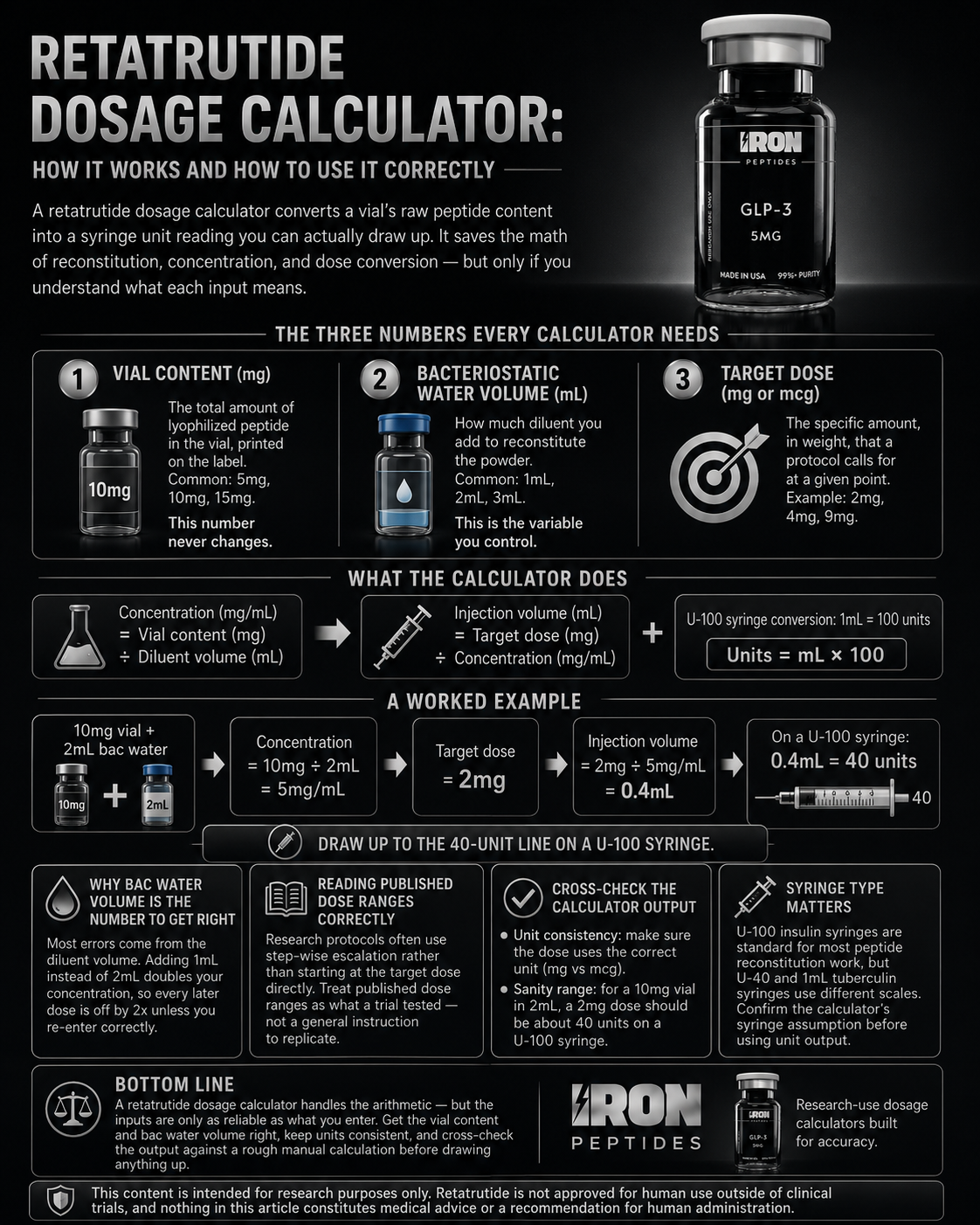
Every retatrutide dosage calculator — including the free tools built into most research-peptide sites — asks for the same three inputs:
1. Vial content (mg). This is the total amount of lyophilized peptide in the vial, printed on the label — commonly 5mg, 10mg, or 15mg for retatrutide research vials. This number never changes regardless of how much liquid you add.
2. Bacteriostatic water volume (mL). This is how much diluent you add to reconstitute the lyophilized powder. Common volumes are 1mL, 2mL, or 3mL. This is the variable you control, and it’s what determines your final concentration.
3. Target dose (mg or mcg). This is the specific amount, in weight, that a protocol calls for at a given point — for example, 2mg, 4mg, or 9mg.
From these three inputs, the calculator does one calculation twice:
Concentration (mg/mL) = Vial content (mg) ÷ Diluent volume (mL)
Injection volume (mL or units) = Target dose (mg) ÷ Concentration (mg/mL)
A Worked Example
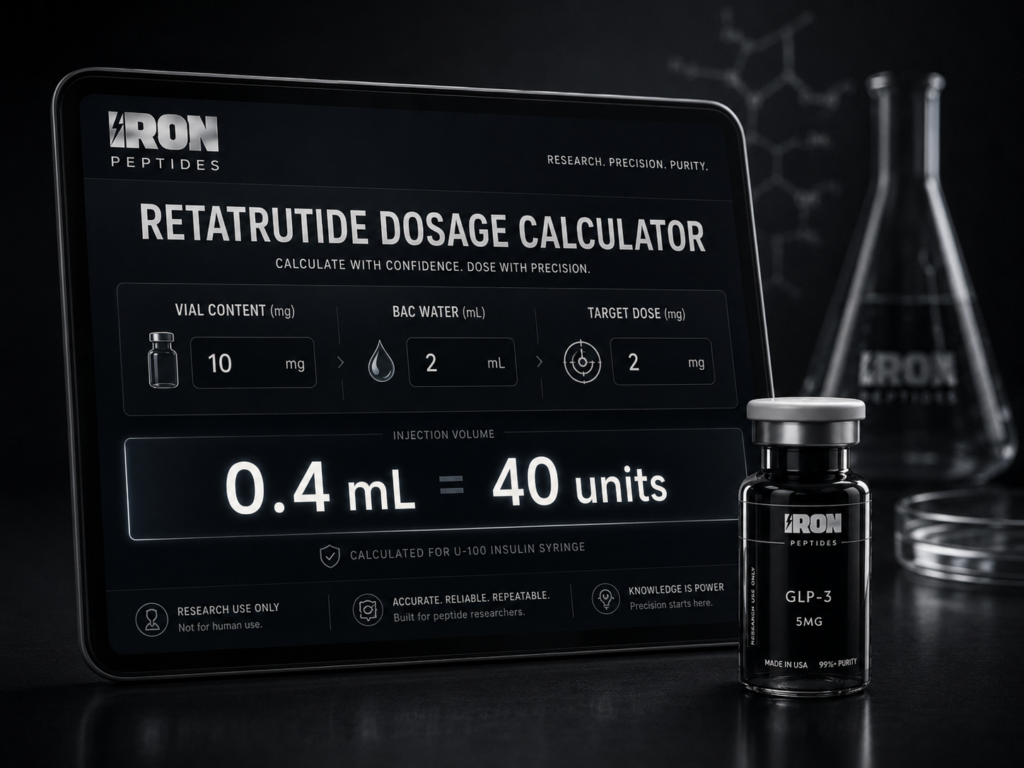
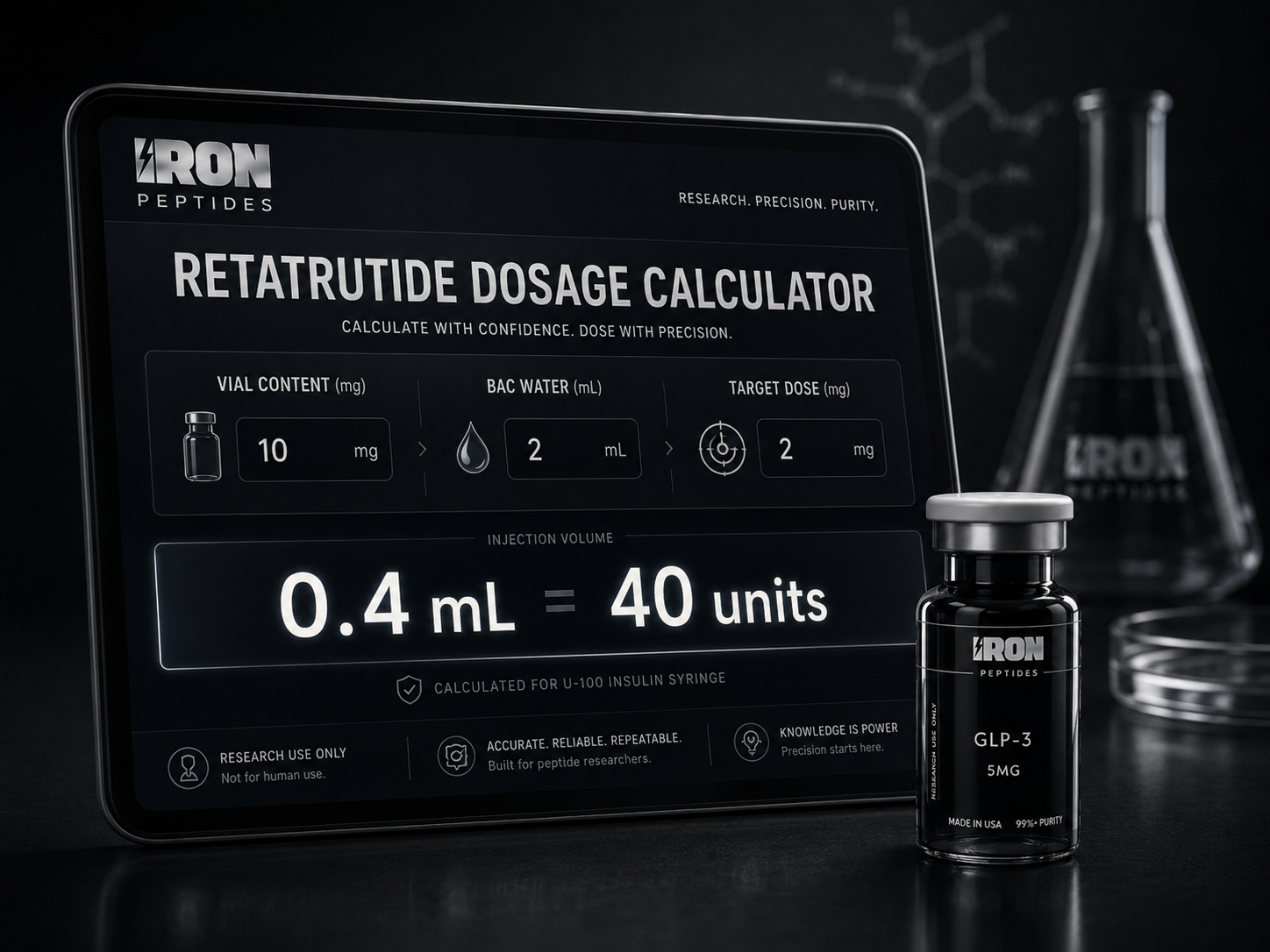
Say a research vial contains 10mg of retatrutide, reconstituted with 2mL of bacteriostatic water.
Concentration = 10mg ÷ 2mL = 5mg/mL
If a protocol step calls for 2mg, the injection volume is:
2mg ÷ 5mg/mL = 0.4mL
On a standard U-100 insulin syringe (where 100 units = 1mL), 0.4mL converts to 40 units. That’s the number the calculator displays, and it’s the number that should match what you draw up.
Why the Bac Water Volume Is the Number to Get Right
Most calculation errors trace back to the diluent volume, not the vial content — because vial content is fixed and printed, but diluent volume is chosen and easy to mistype. Adding 1mL instead of 2mL doubles your concentration, which means every subsequent dose calculation is off by 2x unless the volume is re-entered correctly. Before trusting any calculator output, confirm the diluent volume you actually added matches the volume you entered into the tool — this is the single most common source of a wrong result.
Reading Published Dose Ranges Correctly
Retatrutide’s Phase 3 TRIUMPH-1 trial, with topline results reported by Eli Lilly in May 2026, evaluated three target doses — 4mg, 9mg, and 12mg weekly — with all arms starting at 2mg and escalating in steps every four weeks (2mg → 4mg → 6mg → 9mg → 12mg, depending on target arm) rather than starting at the target dose directly. This step-wise structure is standard in peptide research protocols generally: a low starting point, with dose increases spaced out over time rather than jumping straight to a target amount. When you see a dose range cited in research literature, treat it as a description of what a specific trial protocol tested — not a instruction to replicate without independent verification of your own protocol and research context.
Cross-Checking the Calculator’s Output
A dosage calculator is a conversion tool, not a verification system — it will faithfully calculate an injection volume from whatever numbers you enter, including wrong ones. Two checks catch most errors before they matter:
- Unit consistency. Make sure the target dose is entered in the same unit (mg vs. mcg) that the calculator expects. A dose entered as “2” when the field expects mcg but you meant mg produces a result 1,000x off.
- Sanity range. For a 10mg vial in 2mL of bac water (5mg/mL concentration), a 2mg dose should land around 40 units on a U-100 syringe. If a calculator returns a number wildly outside that range for similar inputs, re-check the vial content and diluent volume first.
Syringe Type Matters
U-100 insulin syringes (100 units per mL) are the standard for peptide reconstitution work, but not universal — U-40 and 1mL tuberculin syringes use different unit scales. A calculator built for U-100 output will give you the wrong number of “units” if you’re actually working with a U-40 syringe, even though the mL volume is identical. Confirm which syringe type the calculator assumes before matching its unit output to your actual equipment.
Bottom Line
A retatrutide dosage calculator handles the arithmetic — concentration from vial content and diluent, then injection volume from target dose and concentration — but the inputs are only as reliable as what you enter. Get the vial content and bac water volume right, keep units consistent, and cross-check the output against a rough manual calculation before drawing anything up.
Iron Peptides maintains research-use dosage calculators alongside its peptide catalog for exactly this reason — pairing the calculation tool with accurate vial and concentration data reduces the most common source of error in reconstitution math.
This content is intended for research purposes only. Retatrutide is not approved for human use outside of clinical trials, and nothing in this article constitutes medical advice or a recommendation for human administration.