

What Are Bioregulator Peptides? Khavinson Peptides and Organ-Specific Repair
MEDICAL DISCLAIMER: This article is for educational and informational purposes only. It does not constitute medical advice, diagnosis, or treatment. Bioregulator peptides are not FDA-approved drugs for the indications discussed below. Always consult a qualified healthcare professional before using any peptide bioregulators or supplements, especially if you have pre-existing medical conditions, take prescription medications, or are pregnant or nursing. The information provided herein is based on available scientific literature and clinical observations, primarily from Eastern European research programs.
TL;DR: The Quick Breakdown
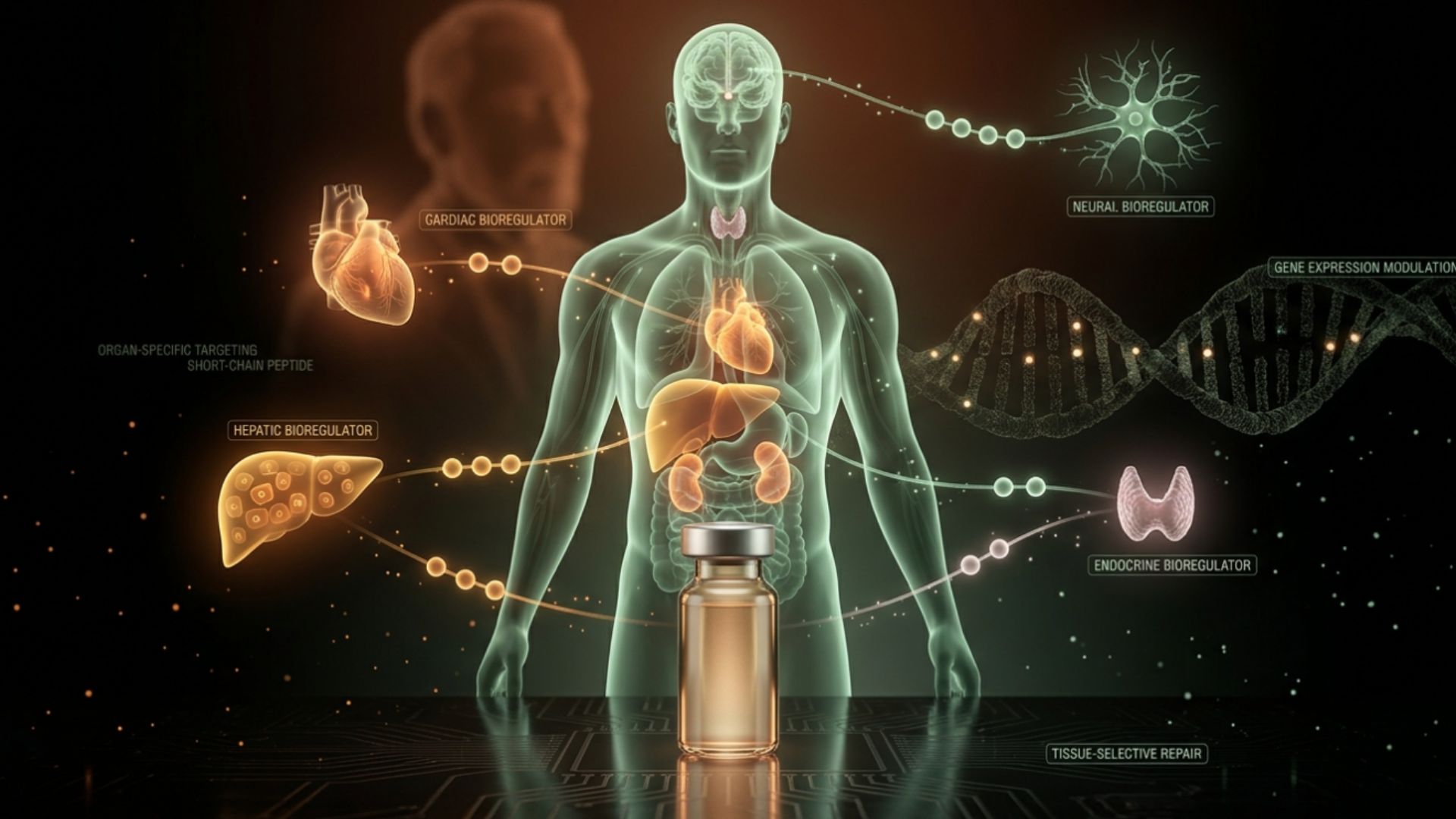
- What they are: Short-chain amino acids (typically 2–7 units) that home in on specific organs and naturally modulate gene expression to restore protein synthesis.
- The Science: Unlike systemic hormones, these peptides penetrate cell nuclei and interact directly with DNA—a form of epigenetic regulation that targets root causes of cellular aging rather than symptoms.
- The Evidence: The strongest human data exists for Thymalin (immune restoration), Cortexin (brain neuroprotection), and Epitalon (pineal gland and telomere maintenance). Most evidence draws on decades of Russian clinical trials.
- Safety & Status: Highly tolerable due to endogenous mimicry, but largely unapproved by Western regulatory bodies like the FDA.
“Peptide bioregulators sit at a fascinating crossroads — decades of Russian clinical use, a growing body of peer-reviewed research, and a mechanism of action that challenges how we think about aging at the molecular level. Anyone exploring these compounds deserves an honest accounting of both the promise and the limitations.”
— Rusty Ryan, Lead Peptide Researcher at Iron Peptides
What Are Bioregulator Peptides and Why Do They Matter?
Bioregulator peptides are a class of short peptides (usually 2 to 4 amino acids long) that function as organ-specific regulators of gene expression. They are not hormones or neurotransmitters. Their relevance to aging stems from the observation that as we age, the body’s natural production of these regulatory peptides declines, causing gene expression patterns to unravel and organ function to deteriorate.
While therapeutic hormonal peptides like BPC-157 or Semaglutide work by binding to cell-surface receptors, bioregulator peptides are small enough to pass through nuclear membranes. They interact directly with DNA to modulate transcription, effectively “reminding” the cell how to synthesize tissue-specific proteins.
The Peptide Theory of Aging
Developed by Professor Vladimir Khavinson, this theory suggests that aging is driven by the progressive decline of endogenous short peptides. In this framework, hormonal decline is a consequence of peptide depletion, not the root cause. By restoring the peptide deficit, you theoretically restore the organ’s ability to function at a youthful level.
History: Cold War Origins
The history of Khavinson peptides is rooted in Soviet military research from the 1970s and 80s. Scientists were tasked with protecting soldiers and cosmonauts from extreme stressors like radiation and chronic fatigue.
Following the dissolution of the Soviet Union, this research was declassified and institutionalized at the Saint Petersburg Institute of Bioregulation and Gerontology. This led to two product classifications:
- Natural Cytomaxes: Derived from young animal tissue extracts.
- Synthetic Cytogens: Precisely manufactured amino acid sequences based on the active components of the natural extracts.
Mechanism of Action: How They Work
Peptide bioregulators resist degradation in the gastrointestinal tract, allowing for oral bioavailability. Once in the bloodstream, they travel to their target tissue, enter the cell nucleus, and bind to specific DNA promoter sequences.
Natural Cytomaxes vs. Synthetic Cytogens
| Feature | Natural Cytomaxes | Synthetic Cytogens |
| Source | Animal tissue extracts | Laboratory synthesis |
| Action Duration | Sustained (up to 4–6 months) | Fast-acting (1.5–2 months) |
| Composition | Complex mixture of organ peptides | Single defined sequence |
| Best Use Case | Long-term support | Acute recovery or fast boost |
Catalog of Khavinson Peptide Bioregulators
| Peptide Name | Target Organ/System | Primary Researched Application |
| Epitalon | Pineal Gland | Melatonin regulation, telomere maintenance |
| Thymalin | Immune System | T-cell restoration, immune modulation |
| Pinealon | Brain (Cerebrovascular) | Neuroprotection, cognitive support |
| Cortexin | Brain (Cerebral Cortex) | Post-stroke recovery, cognitive rehab |
| Retinalamin | Eyes (Retina) | Retinal/Macular degeneration support |
| Chonluten | Cartilage/Joints | Collagen synthesis, osteoarthritis |
| Vesugen | Vascular System | Capillary health, inflammation reduction |
| Pancragen | Pancreas | Glucose metabolism, glycemic control |
| Pielotax | Kidneys | Renal tissue support, nephroprotection |
Clinical and Experimental Evidence
Thymalin and Immune Restoration
During the COVID-19 pandemic, a Russian trial showed that adding Thymalin to standard therapy for elderly patients with severe respiratory distress resulted in a 92% increase in lymphocyte counts and halved hospital mortality rates (from 34.1% down to 16.7%).
Epitalon and Telomeres
Epitalon upregulates telomerase (hTERT) in normal human cells. In a famous 2003 mortality study tracking 266 elderly subjects over 6–8 years, those receiving a combination of Thymic and Pineal peptides experienced a 2- to 4-fold lower mortality rate compared to control groups.
Testing & Tracking: Is it Working?
Bioregulators don’t provide a “buzz.” To know if they are working, you must track structural longevity biomarkers:
- hs-CRP: Measures systemic inflammation (check for Vesugen or Thymalin cycles).
- CBC & Immune Differential: Check lymphocyte and NK cell counts (for Thymalin).
- HbA1c & Fasting Glucose: Check glycemic control (for Pancragen).
- IGF-1: Measures the growth hormone axis baseline.
How to Use Peptide Bioregulators Safely
The Standard Cycling Protocol
These are not daily vitamins. Because they induce lasting chromatin remodeling, the effects persist long after the peptide is cleared.
- Dose: 1–2 capsules daily (10–20 mg).
- Duration: 10 to 20 days.
- Frequency: Repeat the cycle only every 3 to 6 months.
Contraindications
- Active Autoimmune Disease: Thymalin could theoretically amplify an overactive immune response.
- Active Malignancies: Any compound encouraging cellular proliferation should be discussed with an oncologist.
- Pregnancy/Breastfeeding: No safety data exists.
Frequently Asked Questions
Are they legal?
In Russia, many are registered pharmaceuticals. In the U.S., they are not FDA-approved. As of 2026, the FDA has placed compounds like Epitalon in a regulatory “limbo,” meaning they are mostly available as “research chemicals.”
How long until I see results?
Subjective improvements (like better sleep) may appear in 10–20 days. Objective shifts (blood work) should be measured 3–6 months after the cycle ends.
Can I take them with other medications?
Generally, they are compatible with vitamins and supplements. However, those on hormone replacement, blood thinners, or immunosuppressants must seek medical supervision.
Conclusion
Peptide bioregulators offer a unique approach to longevity by attempting to switch repair mechanisms back “on” at the DNA level. While the data from Eastern Europe is vast, the lack of Western Phase III trials remains a barrier for mainstream adoption. For those exploring these compounds, the key is targeted organ focus, baseline lab testing, and disciplined cycling.
Related Articles
Updated: May 30, 2026 Reviewed by: Rusty Ryan, Lead Formulation Specialist at Iron Peptides. “Most people researching
- June 23, 2026
Last Updated: May 30, 2026 Medically Reviewed by: Dr. Sarah Mitchell, MD, Board-Certified Immunologist Medical Disclaimer: This
- June 22, 2026
MEDICAL DISCLAIMER: This article is for educational and informational purposes only. It does not constitute medical advice,
- June 21, 2026