The research peptide market is unregulated, and many suppliers sell substandard products. The biggest problem is that it’s difficult to tell a good peptide from a bad one, because they look the same on the outside. One vial from a reputable manufacturer contains exactly what is listed on the label. But another might contain less of the active ingredient than stated, or a completely different substance, or impurities resulting from substandard synthesis. To distinguish one from the other, there is one tool: the peptide COA (certificate of analysis).
Most buyers either don’t request it at all, or they receive it but don’t know how to read it. As a result, a beautifully formatted document creates a sense of reliability without providing any real assurance. That’s why, in this article, we’ll explain what a peptide certificate of analysis is, what to look for in it, and how to tell a genuine one from a fake. This is one of the most useful skills for making informed purchases in this field.
What Is a Peptide COA and Why Does It Matter
A peptide COA is a laboratory document that answers three questions: Is this the compound it claims to be? (identity), how pure is it? (purity), and how much of the active substance does it actually contain? (quantity).
In the regulated pharmaceutical industry, these questions are addressed through government oversight. But in the research peptide market, the COA is the only proof the buyer has. Without it, you’re simply trusting a label with nothing to back it up. That’s exactly why a peptide COA should be a basic requirement when making such purchases.
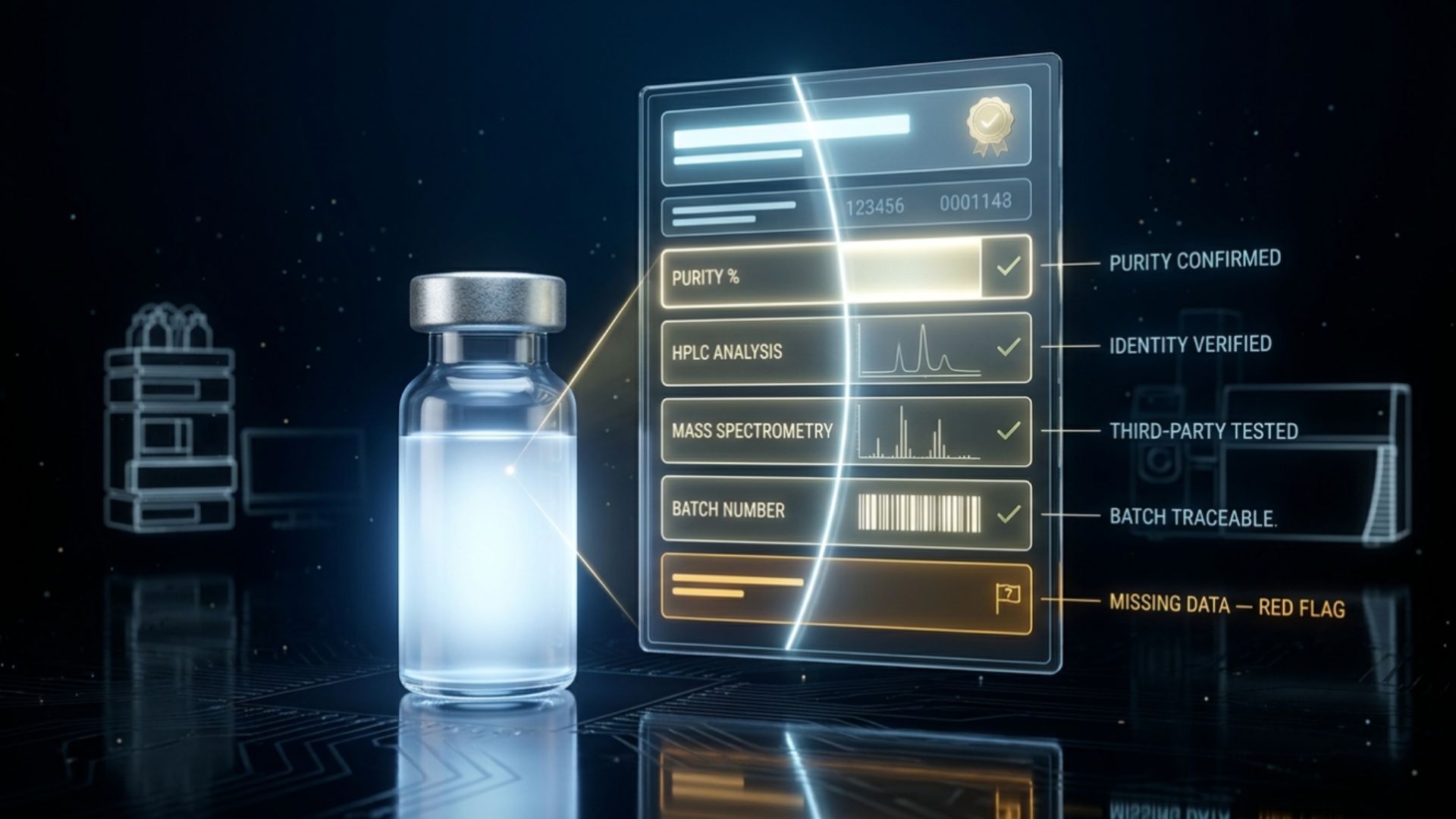
A legitimate COA is issued by an independent third-party laboratory that has taken an actual sample from the production batch and tested it using analytical methods, primarily HPLC (high-performance liquid chromatography) and mass spectrometry. The document records the results of this testing and is linked to a specific batch.
The main problems in the research peptide market are precisely those that a proper COA helps identify: under-synthesis of the active ingredient, incorrect composition, and synthesis-related impurities. A supplier who cannot or will not provide a verifiable COA signals that their product will likely not withstand independent verification.
The Essential Elements Every Peptide COA Should Contain
Before learning how to read a COA, you need to understand what it should contain. Remember that the absence of any key element is already a cause for concern.
A complete peptide COA document contains:
- The name and sequence of the peptide, specifically, what was tested
- Batch/lot number
- Purity percentage based on HPLC data
- Confirmation of molecular weight via mass spectrometry, verifying identity;
- Test date
- Methodology, specifically naming the methods used (HPLC, mass spectrometry)
- Laboratory name and contact information
More comprehensive COAs also include a description of appearance, water content, and acetate content, but these are not always required.
Understanding HPLC Purity and Mass Spectrometry Results
The two main tests on a COA require separate interpretation, as their results differ.
HPLC measures purity. The method separates the components of the sample and shows the proportion of the target peptide and the proportions of impurities, degradation products, or synthesis byproducts. The result is expressed as a percentage; for high-quality research peptides, 98% or higher is considered the benchmark. Anything below 95% indicates poor manufacturing quality. In the report, the HPLC result is usually presented both as a percentage and as a chromatogram – a graph with peaks, where the main peak should dominate, and the minor peaks should be minimal.
Mass spectrometry confirms identity. It measures the peptide’s molecular weight in the sample and compares it to the theoretically predicted value for that compound. A match means that the vial actually contains the specified peptide.
Together, these two tests answer the key questions: “Is this the correct peptide?” (mass spectrometry) and “How pure is it?” (HPLC). A COA with a purity of 98% or higher and a matching molecular weight is exactly what you should look for.
Verifying Third-Party Testing: Why the Lab Matters
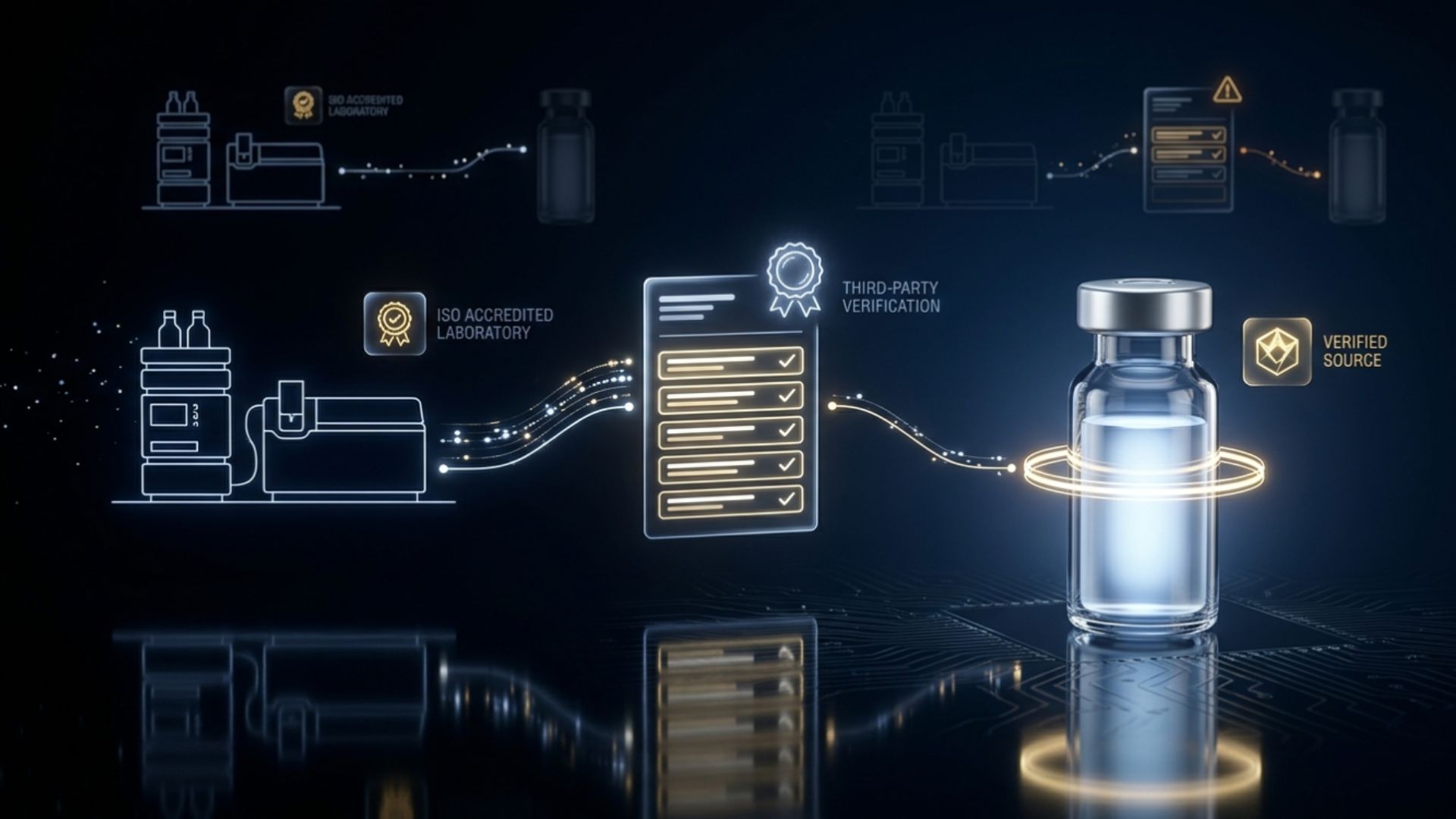
Peptide COA testing is only as valuable as the reliability of the laboratory that conducted it. And here’s the key point: a COA issued by the supplier’s in-house laboratory is practically worthless. The supplier has a direct financial interest in favorable results.
A genuine third-party COA comes from an independent, accredited laboratory unaffiliated with the supplier and committed to protecting its reputation. When verifying peptide COA testing documents, make sure the laboratory is named, has contact information, and actually exists as an institution.
Among the recognized laboratories whose COAs carry real verification value in the research peptide market are Janoshik Analytical, Anabolic Lab, Freedom Diagnostics, and Pure Peptide Sciences. This is precisely why the search term “peptide sciences third-party testing COA” reflects searches by buyers who want concrete confirmation that testing was performed by an independent party, not the seller.
The most reliable way to verify this is to contact the laboratory directly. For example, Freedom Diagnostics allows you to enter information about the peptide supplier directly on its website to find out whether testing was performed.
How to Spot a Fake or Meaningless COA
Unfortunately, there are also fake and meaningless COAs on the research peptide market. Here are some red flags to watch out for:
- No lab name, or the name cannot be verified
- No lot number, or the lot number does not match the vial
- No test date
- Purity percentage is listed without a chromatogram or specific data
- No methodology specified
- The COA is labeled “independent,” but was actually issued by the supplier itself
Some suppliers simply create a fancy-looking document with fabricated data and a made-up lab name. This is easy to verify with a simple online search. A peptide sciences COA from a reputable lab with a matching lot number and complete data, that’s what passes this test.
Can You Test Peptide Purity at Home?
Many people ask how to test peptide purity at home, and the honest answer is this: a true purity test requires laboratory equipment (HPLC, mass spectrometer) that consumers do not have. It is impossible to determine the percentage of purity or confirm molecular identity at home.
However, basic visual checks can help identify obvious issues: a lyophilized peptide should be a white, undamaged powder or “a compact, cake-like disc.” Discoloration, oily stains, or an unusual odor indicate problems. After dissolution in bacteriostatic water, most peptides produce a clear solution; cloudiness or a suspension may signal contamination.
If you really want to test peptide purity for a specific product, a practical option is to request a certificate of analysis from the supplier. Visual inspections catch major issues; only laboratory analysis confirms true purity and identity.
Using COAs to Choose Trustworthy Vendors
Knowing how to read a peptide COA changes how you evaluate suppliers. A reliable supplier makes verifying a COA simple: they publish documents openly, directly on their product pages; work with recognized third-party laboratories; ensure test results are up to date; and are ready to provide a COA upon request.
When a supplier provides a peptide sciences third-party testing COA from a recognized laboratory with a matching lot number and complete data, this is a strong signal of trust. It means the supplier has nothing to hide and is open to external verification.
Signs to watch out for: the supplier does not publish COAs; provides only “internal” documents without an independent laboratory; refuses to provide a COA upon request. Price is not a valid argument in this case, because a cheap, untested product ends up costing more than it seems.
A practical step-by-step guide for selecting a supplier: check for a COA before purchasing; verify that the listed laboratory is legitimate and well-known; confirm that testing was actually performed; and, when placing your first order with a new supplier or for a large order, consider independent verification.
Making COA Verification a Habit: Key Takeaways
The ability to read a COA for peptides boils down to a systematic checklist that, over time, takes less than five minutes and protects both your money and your safety.
Before purchasing: Make sure the supplier publishes COAs for specific products. When reviewing a COA:
- Verify the name and contact information of the independent laboratory
- Find the purity percentage from HPLC (target: 98%+)
- Make sure the molecular weight is confirmed by mass spectrometry
- Check the date, it must be current
Key principle: In an unregulated market, a peptide certificate of analysis is your primary protection, but only if it is genuine, third-party verified, tied to your specific batch, and contains complete data. Making it a habit to check the COA is a responsible approach in a field with no government oversight, where everyone must take responsibility for their own quality control.
Important. The peptides mentioned in this text are provided for informational purposes only. The final decision regarding their use must be made by a qualified specialist, taking into account the individual’s health status, medical history, and current medications.