

Peptides have become such a common part of our lives so quickly that many people have started using them for various purposes. Some use FDA-approved products for weight loss, others need to build muscle mass faster, and still others simply want to stay young longer.
However, a common problem with all peptides is that, a few weeks after starting, many people notice the same thing: the effect, which initially seemed dramatic, gradually “levels off.” In other words, the same dosage regimen no longer works as effectively as it did at the beginning. This article explains what tolerance is and how it’s managed through cycling.
In this article, we’ll explore why cycling matters, which peptides truly require it, which ones can be used differently, and how cycles are structured for popular blends like GLOW and KLOW.
Important. The vast majority of compounds mentioned in this text are investigational and not approved for medical use. Our article is not a recommendation but merely provides informational material about existing approaches and the underlying logic. The decision to use any medications must be made by a qualified physician on an individual basis, based on your medical history.
Why Cycle Peptides? Understanding Tolerance and Receptor Downregulation
To understand why cycling is important, it’s worth starting with how many peptides work at the receptor level. Some compounds work by binding to specific receptors, and with constant stimulation, the body adapts by reducing their number or sensitivity. This process is called downregulation.
This is precisely why a compound that produced a pronounced effect in the first week may seem less effective by the twelfth week. It’s simply that the receptors have become less responsive to the constant signal. A classic example is GH secretagogues (CJC-1295, ipamorelin): with continuous use, desensitization of the pituitary gland has been reported, where the gland stops actively responding to the signal.
The peptide on-off cycle refers to the period without stimulation, during which receptors regain sensitivity and return to their original level of responsiveness. The result is that each new “active” cycle once again produces a pronounced effect. It’s important to understand that not all peptides downregulate receptors in the same way – some anabolic compounds work through mechanisms that are less prone to tolerance. But for those peptides where this is relevant, a peptide cycle is the difference between a protocol that continues to work for years and one that gradually stops producing results.
Do You Need to Cycle Peptides? It Depends on the Type
Do you need to cycle peptides? The answer depends entirely on the specific compound, and different categories follow different rules:
- GH secretagogues (CJC-1295/ipamorelin, sermorelin, MK-677) do indeed require cycling. With continuous use, receptor desensitization has been reported, so “on/off” cycles are important for achieving sustainable results.
- Healing peptides (BPC-157, TB-500), on the other hand, are more often associated with a specific goal rather than with tolerance. They are used until the healing process is complete, rather than cycled to allow the receptors to “rest.”
- Metabolic peptides (e.g., MOTS-c) benefit from cycling as a way to avoid an adaptation “plateau.”
- Cosmetic and longevity peptides behave differently: some (such as Epitalon) are, by their very nature, used in short, intensive cycles with long intervals, while others (for example, topical GHK-Cu) are described as compounds that can be used more continuously.
- GLP-1 medications (semaglutide, tirzepatide), in turn, are used continuously for long-term weight management rather than cycled.
How Long to Cycle Peptides – General Guidelines
There is no single answer to how long to cycle peptides, but several general guidelines emerge from discussions. The most commonly described approach is “an active period long enough for results to manifest, and a break long enough for receptors to recover.”
Some prefer shorter, more frequent cycles – for example, one-week active periods with short breaks – for certain compounds, maintaining regularity while incorporating periodic “sensitivity recovery.” Compounds with an intensive cyclical approach are characterized by short “bursts” of use spaced out over quarters.
There is one key principle here: the break must be long enough to restore receptor sensitivity truly. However, the specific duration for a given person and compound must be determined on an individual basis, taking into account their health status and under a specialist’s supervision.
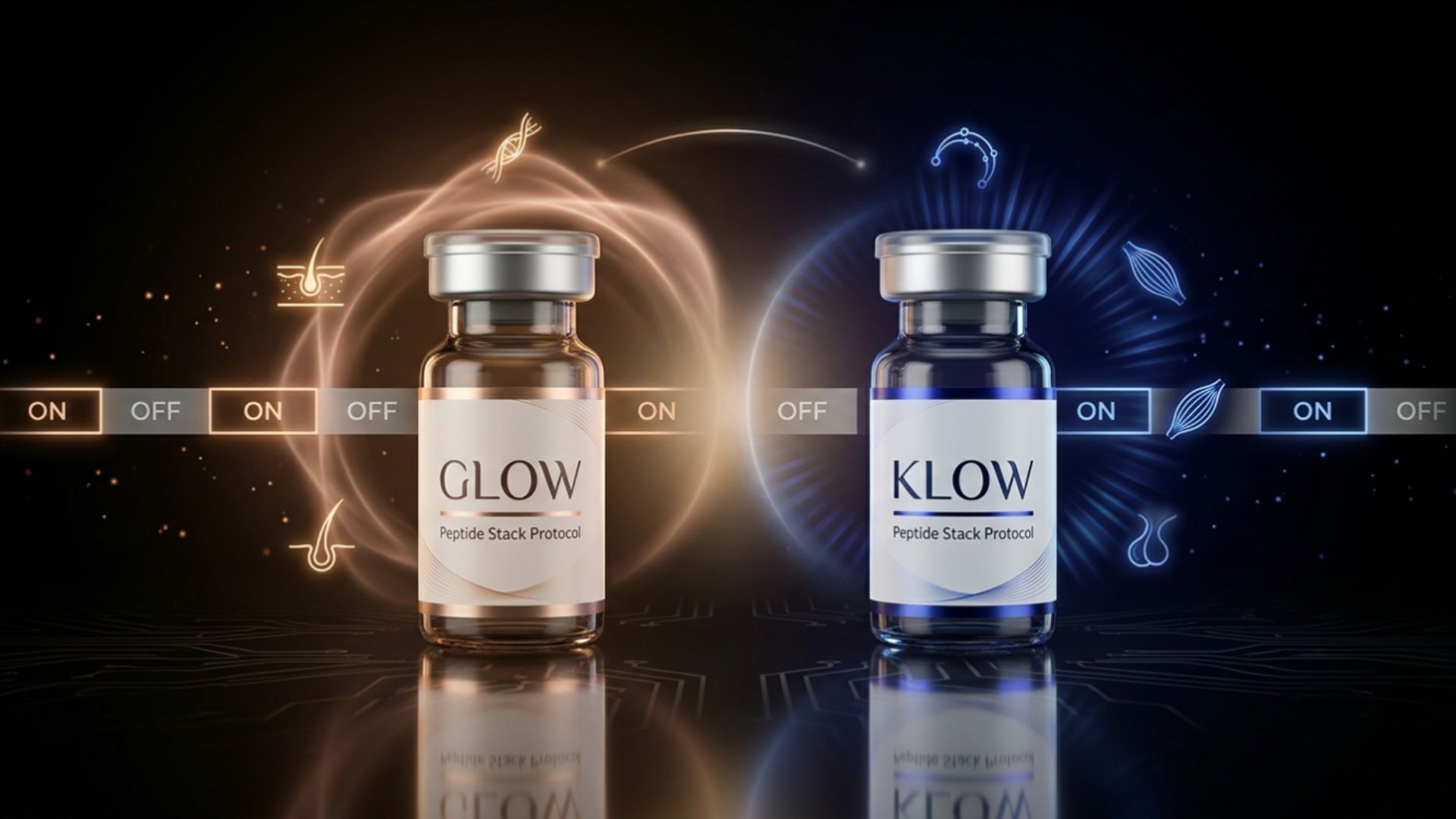
Cycling Popular Stacks – GLOW and KLOW Protocols
Popular peptide blends, such as GLOW and KLOW, require special attention because they combine multiple compounds with distinct properties. The GLOW peptide cycle (typically GHK-Cu, BPC-157, and TB-500) is described as a multi-week active phase followed by a break. The GHK-Cu component supports effects on the skin and tissues, while BPC-157 and TB-500 promote healing and recovery.
These are primarily healing and cosmetic components, rather than compounds with pronounced receptor downregulation. Therefore, GLOW is often described as a blend that allows for longer active periods with less strict breaks compared to stacks based on GH secretagogues. However, this varies greatly from person to person, and the final decision rests with a specialist!
The KLOW peptide cycle (GHK-Cu, BPC-157, TB-500, and additionally KPV) follows a similar logic: an active phase followed by a break, with KPV adding an anti-inflammatory effect and supporting GIT recovery. For both mixtures, the rationale behind cycling is more about giving the body a rest and evaluating the results than about managing significant tolerance. Such protocols are often tied to a specific goal (improving skin condition, recovery, healing), after which a break is taken to assess progress and, if necessary, the course is resumed. The duration of cycles in each case should be based on the goal and the body’s response, rather than on a one-size-fits-all schedule.
SS-31 and Specialized Peptide Cycles
Some peptides require a distinct cycling strategy due to their specific mechanism of action. SS-31 peptide cycle (the compound SS-31 is a peptide that targets mitochondria) works differently from receptor-dependent peptides. SS-31 works by stabilizing mitochondrial function and reducing oxidative stress at the cellular level.
Since it does not rely on receptor stimulation, which is prone to downregulation, SS-31 cycling is more often structured around specific goals and periods for evaluating results. Cycles lasting several weeks are typically described to support mitochondrial function, with breaks to assess the effect.
A broader conclusion for any peptide cycling protocol: the optimal cycle structure depends on the specific mechanism. Receptor-dependent peptides require tolerance-oriented cycles; mitochondrial, longevity, and immune peptides follow logic based on their specific goals or theoretical models. Before applying a single approach to all compounds at once, it is worth understanding each compound’s mechanism and discussing it with your doctor.
How to Structure a Peptide Tolerance Break
A peptide tolerance break is that very “off” period that restores receptor sensitivity, and its structure matters. For peptides prone to tolerance (GH secretagogues), an effective break means completely stopping use, not simply reducing the dose, for a period long enough for receptor sensitivity to return to baseline. According to reports, after prolonged cycles, some users prefer longer breaks to ensure full recovery.
Signs that a break is needed:
- A gradual decrease in effect despite consistent use
- The feeling that “more” is needed to achieve the same results
- Simply the completion of the planned active period
During the break, previously achieved results (such as changes in body composition or healing progress) are often maintained while receptor sensitivity recovers. Experts use this period to assess the benefits of the cycle and decide whether to repeat it. Some people continue to use other compounds (ones less prone to tolerance) during the break from GH secretagogues to maintain other effects.
Building a Sustainable Long-Term Cycling Plan
A sustainable peptide cycling protocol for the long term involves coordinating multiple compounds throughout the year, taking into account each compound’s individual cycling logic. The principle is to schedule compounds according to their own optimal timelines, rather than cramming everything into a single rigid cycle.
A practical annual plan might look like this (general information; the final decision always rests with your doctor):
- Compounds prone to tolerance (GH secretagogues) are taken in multi-week cycles with breaks.
- Healing mixtures (GLOW, KLOW, Wolverine) are used in cycles tied to a specific goal as needed.
- Intensive-cycle compounds (Epitalon) are incorporated in short “bursts” with long intervals between them.
- Compounds that allow for more continuous use (topical GHK-Cu, GLP-1 preparations) are used according to an individualized schedule.
Many plan this approach a year in advance – for example, cycles of GH secretagogues during specific seasons, healing mixtures as needed, and Epitalon periodically. Tracking results throughout this process helps refine the timing. The essence of sustainable cycling is simple: do not use everything continuously (this breeds tolerance and wastes the compound) and do not “overcycle” tolerance-resistant peptides unnecessarily. A well-thought-out peptide cycle plan maximizes results, minimizes tolerance, controls costs, and preserves the long-term effectiveness of each compound rather than “burning it out” through constant use.
Cycling Best Practices and Common Mistakes to Avoid
Effective cycling boils down to a few basic practices and avoiding common mistakes.
What works: aligning the cycle structure with the mechanism of a specific peptide (receptor-dependent compounds require breaks to restore sensitivity, while others follow a goal-oriented approach); making breaks long enough to restore sensitivity truly; tracking results throughout the cycle to spot a “plateau” and the need for a break in time; and planning cycles in advance rather than reacting after the fact, when results have already noticeably declined.
Common mistakes: continuous use of peptides prone to tolerance (probably the most common mistake, leading to wasted compound and diminishing effects); breaks that are too short to allow receptors to recover; excessive cycling of tolerance-resistant compounds where it is unnecessary; chasing higher doses instead of taking a break when tolerance sets in; and attempting to apply the same approach to all peptides at once.
The question of how to cycle peptides is not a set of arbitrary rules, but rather an understanding of each compound’s mechanism and what the body needs to continue responding to it. With the right approach, cycling allows you to maintain stable results over months and years. However, any decisions regarding specific regimens, cycle durations, and compound combinations must be addressed on an individual basis and under the supervision of a specialist.
All peptides mentioned in this text are provided for informational purposes only. The final decision regarding their use, as well as the choice of a cycling regimen, must be made by a qualified specialist, taking into account the individual’s health status, medical history, and current medications.