
Around ages 25-30, collagen production in our skin begins to decline by about 1 percent per year. This is precisely why skin loses its firmness over time, and fine lines and wrinkles begin to appear. But thanks to modern research and technology, it is now possible to prevent this. This is exactly where peptides for skin come into play. They are not just another moisturizing ingredient, as anti-wrinkle creams promise. Peptides are compounds that signal skin cells to produce more collagen, elastin, and other proteins that keep the skin firm.
In this article, we’ll explore what peptides actually do for the skin, which ones show the most convincing results, and how the three main methods of using them compare: serum formulas, microneedling, and injectable options.
Important. The information in this article is provided solely for educational purposes and does not constitute medical advice or a recommendation for use. The decision to use any peptides, as well as the choice of a specific treatment protocol, should be made by a qualified professional (doctor, dermatologist, or aesthetician), taking into account your individual health condition.
What Are Peptides for Skin and What Do They Actually Do?
To start from the beginning: peptides are short chains of amino acids, the same “building blocks” that make up collagen and elastin (the proteins that form the skin’s structure). But what do peptides do for the skin? They act as messenger molecules: they give skin cells a command, and the cells carry it out. For example: synthesize more collagen, repair damage, retain moisture, reduce inflammation, or strengthen the protective barrier.
Different peptides address different tasks. Signaling peptides (e.g., Matrixyl / palmitoyl pentapeptide) trigger collagen synthesis. Transport peptides, which include copper peptides, deliver the trace elements necessary for collagen synthesis and tissue healing. Peptides that influence the transmission of nerve impulses to muscles (Argireline) reduce the amplitude of facial contractions, producing a gentle effect similar to that of Botox. Enzyme-inhibiting peptides slow the breakdown of existing collagen.
So, what are peptides for skin in practical terms? They are active ingredients that take skincare beyond superficial hydration and into the realm of actual structural work on the skin. Unlike harsh active ingredients that often irritate the skin, peptides are generally well-tolerated and suitable for most skin types, making them a cornerstone of modern anti-aging regimens.
Copper Peptides for Skin – The Research-Backed Standout
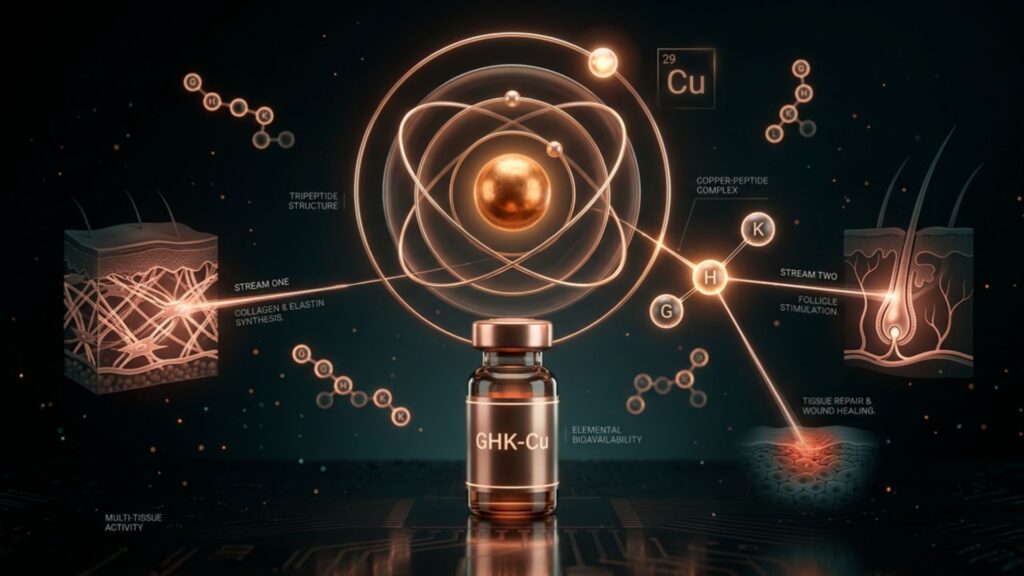
Among all peptides in cosmetology, copper peptides for skin – primarily GHK-Cu, copper tripeptide-1 – stand out for having the most robust scientific basis.
So what do copper peptides do for your skin? GHK-Cu delivers copper ions, which are an essential cofactor for the enzymes responsible for collagen and elastin synthesis.
Studies show that copper peptides:
- Stimulate collagen synthesis
- Support healing processes
- Improve skin elasticity and density
- Reduce the appearance of fine lines
- Help even out skin tone in cases of hyperpigmentation
- Support skin repair processes
Additionally, they possess antioxidant properties that help protect against oxidative stress, a key factor in premature aging.
The unique feature of copper peptides is that they work on multiple levels simultaneously: they build new collagen while helping to “rebuild” already damaged tissue. With regular use, users most often report a smoother texture, increased skin density, and a healthier overall appearance. An important formulation note: copper peptides should not be combined with vitamin C, acids, or retinol in a single application. These specific ingredients can deactivate the copper complex. When used correctly, copper peptides are considered one of the most reliable, research-backed tools in anti-aging skincare.
Topical Peptides and Microneedling – Enhancing Absorption
Topical peptides have one limitation: the skin barrier is naturally designed to prevent large molecules from penetrating deeply, and peptides are large enough that they struggle to reach the dermis, where collagen is actually synthesized.
This is where microneedling comes into play. Creating thousands of microchannels in the skin allows peptides to penetrate much deeper and more effectively reach the layers where they can trigger collagen production. The combination of “peptide serum immediately after microneedling” significantly increases absorption compared to simply applying it to the skin’s surface. At the same time, microneedling itself triggers the skin’s natural response to micro-injuries (healing and collagen synthesis), creating a cumulative effect.
For home use, a popular combination is a derma roller with needles of the appropriate length paired with a serum based on copper peptides for skin. Professional microneedling is deeper and more controlled – when combined with peptides, it delivers more pronounced results for those willing to invest in clinic-based treatments. But remember that self-treatment is unwise. First, consult a specialist for recommendations.
Injectable Peptides for Skin – Stronger Results, More Commitment
Injectable peptides for skin work fundamentally differently: the active ingredients are injected directly into or beneath the skin, bypassing the absorption barrier entirely and reaching concentrations unattainable with topical formulas.
Peptides for skin injection – typically GHK-Cu, which is administered subcutaneously or via mesotherapy – enter directly into the dermis, where they can maximally stimulate collagen production and tissue remodeling.
The results are usually more pronounced and appear faster than with topical application: a more noticeable lift, improved texture, and a more significant reduction in sagging.
In addition to copper peptides, GH secretagogues – such as CJC-1295/ipamorelin – systemically influence skin quality as part of their broader anti-aging effect, increasing collagen production throughout the body rather than just locally.
There is also a downside: injectable peptides require professional administration, are associated with more pronounced discomfort, are more expensive, and, for investigational injectable formulations, it is critically important that they come from suppliers with verified third-party analysis certificates. This format is suitable for those who expect results superior to those provided by topical formulas and are prepared for additional costs and complexity. Remember that the procedure must be performed by a qualified specialist who will prescribe these medications for you (do not self-medicate – it is dangerous).

Peptides for Skin Tightening and Loose Skin
One of the most common searches in this topic is peptides for skin tightening, that is, addressing the loss of firmness that comes with age, after weight loss, or due to sun damage. The mechanism here is the same – stimulating the production of collagen and elastin: as these structural proteins increase, the skin gradually regains some of its firmness and “bounce.”
Best peptides for skin tightening are, first and foremost, copper peptides (GHK-Cu) due to their proven effect on collagen synthesis, often combined with signaling peptides such as Matrixyl.
When it comes to peptides for loose skin – especially after significant weight loss or pregnancy – it’s important to be realistic about expectations: peptides can significantly improve mild to moderate sagging by restoring collagen. But they are no substitute for surgical correction in cases of severe ptosis, when the skin has already lost a significant portion of its structural integrity.
Best injectable peptides for skin tightening provide a more pronounced lifting effect compared to topical formulations for those seeking maximum results. A realistic approach to skin tightening is based on the idea that peptides work best as a tool for preventing and correcting mild to moderate sagging, rather than as a substitute for major surgical correction.
- Regular use of copper peptides – topically with microneedling or in an injectable format for a more pronounced effect.
- A willingness to wait for results over the course of several months, rather than weeks.
- Combination with other practices that support collagen production.
How Long Until Peptides Show Results on Skin
Peptides for skin work within the natural skin renewal cycle, and this process cannot be “skipped.” In young skin, cells renew approximately every 28 days; with age, this cycle slows down, and collagen restructuring takes even longer.
A realistic timeline looks like this: by weeks 2-4, improvements in hydration, smoothness, and texture are usually noticeable; by weeks 6-8, the appearance of fine lines diminishes and skin tone evens out; and structural changes (such as firmness, lifting, and the cumulative effect of collagen regeneration) become apparent only after 3-6 months. Injectable peptides and topical formulations, combined with microneedling, usually produce visible results faster because they reach the dermis more effectively.
The most common mistake is to give up on peptide skincare after a couple of weeks, expecting an instant transformation. Collagen production is a process that takes months, and it is precisely regular photos, taken under consistent lighting at 4-week intervals, that reveal cumulative results invisible over the short term.
Best Peptides for Skin – Choosing the Right Approach
Best peptides for skin depend on your goals, budget, and willingness to commit to the process:
- For general anti-aging prevention, copper peptides (GHK-Cu) combined with signaling peptides (Matrixyl) in high-quality serum formulas, when used regularly.
- For expression lines, peptides that affect neuromuscular transmission (Argireline).
- For firmness and lifting, a copper peptide-based formula, ideally enhanced with microneedling.
- For maximum results, those ready for this level of commitment may consider injectable GHK-Cu or systemic GH secretagogues .
Product selection plays a huge role here: effective formulas contain significant concentrations of active ingredients, use stable formulations, and feature packaging that protects peptides from degradation by light and air. For injectable forms, third-party analysis certificates confirming formulation purity are mandatory.
Best peptides for skin work for those who give them time, choose the right formulas, and approach the process without expecting an instant miracle. Remember that peptides are a tool with a real scientific basis, not a one-time magic fix.
Building Your Peptide Skincare Routine – Practical Takeaways
A practical approach to peptide skincare starts with choosing a method that fits your goals and level of commitment. The approach should be developed by a qualified specialist who understands your specific situation and knows what will help you.
Most often, at the basic level, skincare professionals recommend using a copper peptide serum in combination with sun protection. At the intermediate level, they may suggest adding microneedling to enhance peptide penetration. And at the advanced level, a skincare professional may recommend injectable options to achieve the best results.
Several principles apply at any level: Peptides for skin remain one of the most studied and proven tools in anti-aging skincare. But this is a tool that rewards patience and consistency, not quick results. With a routine tailored to your goals, time, and regularity, the cumulative effect on collagen will manifest on its own.
- Do not combine copper peptides in a single application with vitamin C, retinol, or acids
- Allow at least 3 months before evaluating the results
- Protect your “investment” with daily sun protection
- Document progress with photos taken under consistent conditions
- For injectable formulations, pay attention to verified sourcing and purity of the composition
Important. This material is for informational purposes only and does not replace a consultation with a cosmetologist or dermatologist. Decisions regarding injectable procedures, experimental peptides, and individual skin reactions should be made in consultation with a specialist – especially if you have chronic skin conditions, allergies, or are taking other medications.